Movie
Movie Controller


+ Open data

- Basic information
| Entry | Database: PDB / ID: 7occ | |||||||||
|---|---|---|---|---|---|---|---|---|---|---|
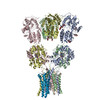
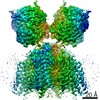
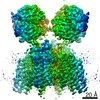
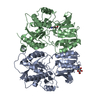
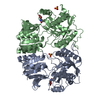
| Title | NTD of resting state GluA1/A2 heterotertramer | |||||||||
 Components Components |
| |||||||||
 Keywords Keywords | MEMBRANE PROTEIN / AMPAR / ion channels / neurotransmission | |||||||||
| Function / homology |  Function and homology information Function and homology informationCargo concentration in the ER / cellular response to ammonium ion / axonal spine / COPII-mediated vesicle transport / positive regulation of locomotion involved in locomotory behavior / positive regulation of membrane potential / response to sucrose / regulation of monoatomic ion transmembrane transport / cellular response to L-glutamate / myosin V binding ...Cargo concentration in the ER / cellular response to ammonium ion / axonal spine / COPII-mediated vesicle transport / positive regulation of locomotion involved in locomotory behavior / positive regulation of membrane potential / response to sucrose / regulation of monoatomic ion transmembrane transport / cellular response to L-glutamate / myosin V binding / neuron spine / Trafficking of AMPA receptors / proximal dendrite / response to arsenic-containing substance / cellular response to dsRNA / long-term synaptic depression / ligand-gated calcium channel activity / dendritic spine membrane / beta-2 adrenergic receptor binding / Synaptic adhesion-like molecules / cellular response to peptide hormone stimulus / spinal cord development / regulation of synaptic plasticity by chemical substance / spine synapse / dendritic spine neck / dendritic spine cytoplasm / response to phorbol 13-acetate 12-myristate / cellular response to amine stimulus / dendritic spine head / response to psychosocial stress / peptide hormone receptor binding / response to morphine / Activation of AMPA receptors / ligand-gated monoatomic cation channel activity / behavioral response to pain / perisynaptic space / neuronal cell body membrane / response to lithium ion / Trafficking of GluR2-containing AMPA receptors / AMPA glutamate receptor activity / protein kinase A binding / AMPA glutamate receptor clustering / regulation of receptor recycling / neuronal action potential / kainate selective glutamate receptor activity / response to electrical stimulus / adenylate cyclase binding / AMPA glutamate receptor complex / extracellularly glutamate-gated ion channel activity / ionotropic glutamate receptor complex / cellular response to glycine / immunoglobulin binding / asymmetric synapse / Unblocking of NMDA receptors, glutamate binding and activation / G-protein alpha-subunit binding / glutamate receptor binding / positive regulation of synaptic transmission / conditioned place preference / long-term memory / regulation of synaptic transmission, glutamatergic / response to fungicide / postsynaptic density, intracellular component / extracellular ligand-gated monoatomic ion channel activity / cytoskeletal protein binding / glutamate-gated receptor activity / cellular response to brain-derived neurotrophic factor stimulus / regulation of long-term synaptic depression / synapse assembly / glutamate-gated calcium ion channel activity / somatodendritic compartment / presynaptic active zone membrane / ionotropic glutamate receptor binding / ionotropic glutamate receptor signaling pathway / excitatory synapse / dendrite cytoplasm / ligand-gated monoatomic ion channel activity involved in regulation of presynaptic membrane potential / dendrite membrane / cellular response to amino acid stimulus / positive regulation of excitatory postsynaptic potential / response to cocaine / SNARE binding / dendritic shaft / synaptic membrane / neuromuscular junction / establishment of protein localization / synaptic transmission, glutamatergic / PDZ domain binding / protein tetramerization / long-term synaptic potentiation / transmitter-gated monoatomic ion channel activity involved in regulation of postsynaptic membrane potential / receptor internalization / cerebral cortex development / regulation of synaptic plasticity / response to toxic substance / response to nutrient levels / recycling endosome / cellular response to growth factor stimulus / postsynaptic density membrane / modulation of chemical synaptic transmission / Schaffer collateral - CA1 synapse Similarity search - Function | |||||||||
| Biological species |   Rattus norvegicus (Norway rat) Rattus norvegicus (Norway rat) | |||||||||
| Method | ELECTRON MICROSCOPY / single particle reconstruction / cryo EM / Resolution: 3.4 Å | |||||||||
 Authors Authors | Zhang, D. / Watson, J.F. / Matthews, P.M. / Cais, O. / Greger, I.H. | |||||||||
| Funding support | 2items
| |||||||||
 Citation Citation | Journal: Nature / Year: 2021 Title: Gating and modulation of a hetero-octameric AMPA glutamate receptor. Authors: Danyang Zhang / Jake F Watson / Peter M Matthews / Ondrej Cais / Ingo H Greger /   Abstract: AMPA receptors (AMPARs) mediate the majority of excitatory transmission in the brain and enable the synaptic plasticity that underlies learning. A diverse array of AMPAR signalling complexes are ...AMPA receptors (AMPARs) mediate the majority of excitatory transmission in the brain and enable the synaptic plasticity that underlies learning. A diverse array of AMPAR signalling complexes are established by receptor auxiliary subunits, which associate with the AMPAR in various combinations to modulate trafficking, gating and synaptic strength. However, their mechanisms of action are poorly understood. Here we determine cryo-electron microscopy structures of the heteromeric GluA1-GluA2 receptor assembled with both TARP-γ8 and CNIH2, the predominant AMPAR complex in the forebrain, in both resting and active states. Two TARP-γ8 and two CNIH2 subunits insert at distinct sites beneath the ligand-binding domains of the receptor, with site-specific lipids shaping each interaction and affecting the gating regulation of the AMPARs. Activation of the receptor leads to asymmetry between GluA1 and GluA2 along the ion conduction path and an outward expansion of the channel triggers counter-rotations of both auxiliary subunit pairs, promoting the active-state conformation. In addition, both TARP-γ8 and CNIH2 pivot towards the pore exit upon activation, extending their reach for cytoplasmic receptor elements. CNIH2 achieves this through its uniquely extended M2 helix, which has transformed this endoplasmic reticulum-export factor into a powerful AMPAR modulator that is capable of providing hippocampal pyramidal neurons with their integrative synaptic properties. | |||||||||
| History |
|
- Structure visualization
| Movie |
Movie viewer |
|---|---|
| Structure viewer | Molecule: MolmilJmol/JSmol |
- Downloads & links
-Download
| PDBx/mmCIF format | 7occ.cif.gz | 306.3 KB | Display | PDBx/mmCIF format |
|---|---|---|---|---|
| PDB format | pdb7occ.ent.gz | 217.3 KB | Display | PDB format |
| PDBx/mmJSON format | 7occ.json.gz | Tree view | PDBx/mmJSON format | |
| Others |  Other downloads Other downloads |
-Validation report
| Arichive directory | https://data.pdbj.org/pub/pdb/validation_reports/oc/7occftp://data.pdbj.org/pub/pdb/validation_reports/oc/7occ | HTTPS FTP |
|---|
-Related structure data
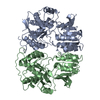
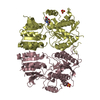
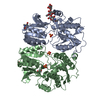
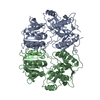
| Related structure data | 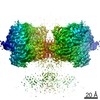 12803MC  7ocaC  7ocdC 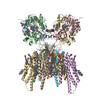 7oceC 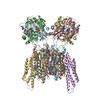 7ocfC M: map data used to model this data C: citing same article ( |
|---|---|
| Similar structure data |
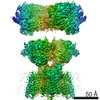
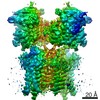
-Links
 PDBj
PDBj

- Assembly
| Deposited unit | 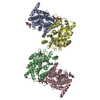
|
|---|---|
| 1 | 
|
| 2 | 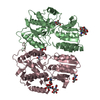
|
-Components
| #1: Protein | Mass: 102661.930 Da / Num. of mol.: 2 Source method: isolated from a genetically manipulated source Source: (gene. exp.) Rattus norvegicus (Norway rat) / Gene: Gria1, Glur1 / Production host:  Homo sapiens (human) / References: UniProt: P19490 Homo sapiens (human) / References: UniProt: P19490#2: Protein | Mass: 96247.055 Da / Num. of mol.: 2 Source method: isolated from a genetically manipulated source Source: (gene. exp.) Rattus norvegicus (Norway rat) / Gene: Gria2, Glur2 / Production host: Homo sapiens (human) / References: UniProt: P19491#3: Polysaccharide | Source method: isolated from a genetically manipulated source #4: Polysaccharide | 2-acetamido-2-deoxy-beta-D-glucopyranose-(1-4)-2-acetamido-2-deoxy-beta-D-glucopyranose Source method: isolated from a genetically manipulated source #5: Sugar | ChemComp-NAG /  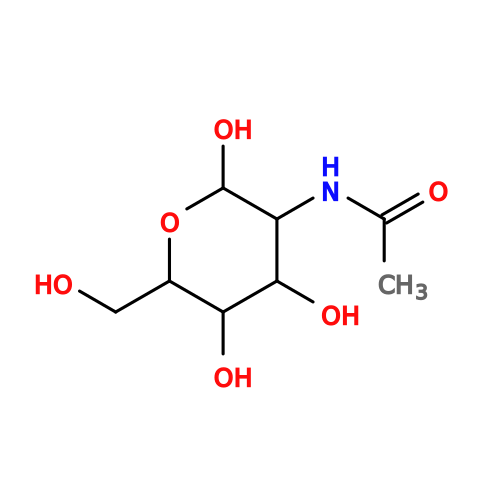 Type: D-saccharide, beta linking / Mass: 221.208 Da / Num. of mol.: 6 / Source method: obtained synthetically / Formula: C8H15NO6 Type: D-saccharide, beta linking / Mass: 221.208 Da / Num. of mol.: 6 / Source method: obtained synthetically / Formula: C8H15NO6Has ligand of interest | N | Has protein modification | Y | |
|---|
-Experimental details
-Experiment
| Experiment | Method: ELECTRON MICROSCOPY |
|---|---|
| EM experiment | Aggregation state: PARTICLE / 3D reconstruction method: single particle reconstruction |
- Sample preparation
| Component | Name: GluA1/A2 heterotertramer in complex with auxiliary subunits TARP gamma 8 and CNIH2 Type: COMPLEX / Entity ID: #1-#2 / Source: RECOMBINANT |
|---|---|
| Molecular weight | Experimental value: NO |
| Source (natural) | Organism: Rattus norvegicus (Norway rat) |
| Source (recombinant) | Organism: Homo sapiens (human) |
| Buffer solution | pH: 8 |
| Specimen | Conc.: 3 mg/ml / Embedding applied: NO / Shadowing applied: NO / Staining applied: NO / Vitrification applied: YES Details: Purified protein was incubated with 100 uM NBQX for at least 30 min on ice before freezing. |
| Vitrification | Cryogen name: ETHANE |
- Electron microscopy imaging
| Experimental equipment |  Model: Titan Krios / Image courtesy: FEI Company |
|---|---|
| Microscopy | Model: FEI TITAN KRIOS |
| Electron gun | Electron source:  FIELD EMISSION GUN / Accelerating voltage: 300 kV / Illumination mode: FLOOD BEAM FIELD EMISSION GUN / Accelerating voltage: 300 kV / Illumination mode: FLOOD BEAM |
| Electron lens | Mode: BRIGHT FIELD |
| Image recording | Electron dose: 50 e/Å2 / Film or detector model: GATAN K3 (6k x 4k) |
- Processing
| EM software |
| |||||||||
|---|---|---|---|---|---|---|---|---|---|---|
| CTF correction | Type: PHASE FLIPPING AND AMPLITUDE CORRECTION | |||||||||
| 3D reconstruction | Resolution: 3.4 Å / Resolution method: FSC 0.143 CUT-OFF / Num. of particles: 228721 / Symmetry type: POINT | |||||||||
| Atomic model building | Protocol: RIGID BODY FIT / Space: REAL | |||||||||
| Atomic model building | PDB-ID: 6QKZ Accession code: 6QKZ / Source name: PDB / Type: experimental model |