






 28LU
28LU
Structure of the Chlamydomonas reinhardtii chlororibosome with factor pY
This is a non-PDB format compatible entry.
Summary for 28LU
| Entry DOI | 10.2210/pdb28lu/pdb |
| EMDB information | 56602 |
| Descriptor | Ribosomal protein S1 homologue, Small ribosomal subunit protein uS14c, 30S ribosomal protein S15, ... (62 entities in total) |
| Functional Keywords | chloroplast, ribosome, translation, chlororibosome |
| Biological source | Chlamydomonas reinhardtii More |
| Total number of polymer chains | 60 |
| Total formula weight | 2670767.53 |
| Authors | Waltz, F.,Kater, L.,Engel, B.D. (deposition date: 2026-02-05, release date: 2026-04-01, Last modification date: 2026-06-24) |
| Primary citation | Waltz, F.,Lehner, P.A.,Van der Stappen, P.,Kater, L.,Pfeffer, S.,Engel, B.D. Chloroplast-encoded small subunit extensions reshape the Chlamydomonas chlororibosome. Biorxiv, 2026 Cited by PubMed Abstract: Chloroplast ribosomes (chlororibosomes) synthesize the core protein components of the photosynthetic apparatus, yet their structural diversity outside flowering plants remains largely unexplored. Here, we combine in situ cryo-electron tomography (cryo-ET) with single-particle cryo-electron microscopy (cryo-EM) to determine the structure of the chlororibosome from the unicellular green alga . Subtomogram averaging of chlororibosomes in their native environment, resolved to ∼5 Å resolution and in distinct translational states, reveals particles both free in the stroma and loosely tethered to thylakoid membranes. These reconstructions uncover an additional "arm" domain on the small subunit. High-resolution single-particle reconstruction of isolated chlororibosomes to ∼2.5 Å, in states bound either to the inhibitory translation factor pY or to a nascent chain-linked P-site tRNA, reveals that this domain is built primarily from extensive chloroplast-encoded insertions and extensions of conserved small subunit proteins, supported by chlororibosome-specific ribosomal proteins. The arm domain is located around the mRNA entry and exit channels, suggesting a role in stabilizing the mRNA trajectory through the small subunit and organizing chloroplast polysomes. Together, these data reveal unexpected structural variation of algal chlororibosomes and suggest that chloroplast translation has diversified substantially even among relatively closely related photosynthetic lineages. PubMed: 41727112DOI: 10.64898/2026.02.07.704542 PDB entries with the same primary citation |
| Experimental method | ELECTRON MICROSCOPY (2.6 Å) |
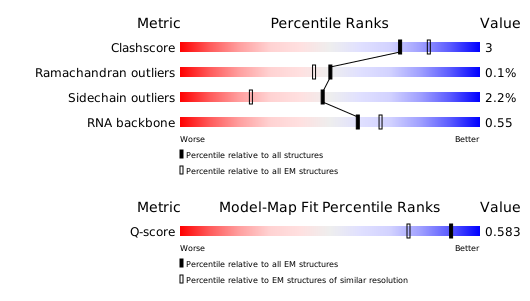
Structure validation
Download full validation report


