 Movie
Movie Controller
 Structure viewers
 About Yorodumi Papers


+Search query
-Structure paper
| Title | Structural landscape of the degrading 26S proteasome reveals conformation-specific binding of TXNL1. |
|---|---|
| Journal, issue, pages | Nat Struct Mol Biol, Vol. 32, Issue 12, Page 2403-2415, Year 2025 |
| Publish date | Nov 6, 2025 |
 Authors Authors | Connor Arkinson / Christine L Gee / Zeyuan Zhang / Ken C Dong / Andreas Martin /  |
| PubMed Abstract | The 26S proteasome targets many cellular proteins for degradation during homeostasis and quality control. Proteasome-interacting cofactors modulate these functions and aid in substrate degradation. ...The 26S proteasome targets many cellular proteins for degradation during homeostasis and quality control. Proteasome-interacting cofactors modulate these functions and aid in substrate degradation. Here we solve high-resolution structures of the redox active cofactor TXNL1 bound to the human 26S proteasome at saturating and substoichiometric concentrations by time-resolved cryo-electron microscopy (cryo-EM). We identify distinct binding modes of TXNL1 that depend on the proteasome conformation and ATPase motor states. Together with biophysical and biochemical experiments, we show that the resting-state proteasome binds TXNL1 with low affinity and in variable positions on top of the Rpn11 deubiquitinase. In contrast, in the actively degrading proteasome, TXNL1 uses additional interactions for high-affinity binding, whereby its C-terminal tail covers the catalytic groove of Rpn11 and coordinates the active-site Zn. Furthermore, these cryo-EM structures of the degrading proteasome capture the ATPase hexamer in several spiral-staircase arrangements that indicate temporally asymmetric hydrolysis and conformational changes in bursts during mechanical substrate unfolding and translocation. Remarkably, we catch the proteasome in the act of unfolding the β-barrel mEos3.2 substrate while the ATPase hexamer is in a particular staircase register. Our findings advance current models for protein translocation through hexameric AAA+ motors and reveal how the proteasome uses its distinct conformational states to coordinate cofactor binding and substrate processing. |
 External links External links | Nat Struct Mol Biol / PubMed:41198955 / PubMed Central |
| Methods | EM (single particle) |
| Resolution | 2.76 - 4.08 Å |
| Structure data | EMDB-47719, PDB-9e8g: EMDB-47720, PDB-9e8h: EMDB-47721, PDB-9e8i: EMDB-47722, PDB-9e8j: EMDB-47723, PDB-9e8k: EMDB-47724, PDB-9e8l: EMDB-47725, PDB-9e8n: EMDB-47726, PDB-9e8o: EMDB-47727, PDB-9e8q: EMDB-71534, PDB-9pdi: EMDB-71537, PDB-9pdl: EMDB-71538, PDB-9pdn:  EMDB-71581: Nub1/Fat10-processing human 26S proteasome bound to TXNL1 with Rpt3 at top of spiral staircase  EMDB-71583: NUB1/FAT10-processing human 26S proteasome bound to TXNL1 with Rpt6 at top of spiral staircase EMDB-71584, PDB-9pf1: |
| Chemicals | 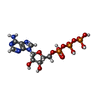 ChemComp-ATP:  ChemComp-MG: 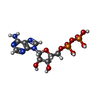 ChemComp-ADP:  ChemComp-ZN: |
| Source |
|
 Keywords Keywords | MOTOR PROTEIN / HYDROLASE/PROTEIN BINDING / 26S Proteasome / Nub1 / Fat10 / HYDROLASE-PROTEIN BINDING complex |


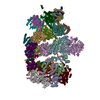


 homo sapiens (human)
 lobophyllia hemprichii (invertebrata)