






 9PYF
9PYF
uPA Inhibitory Fab AB2 Complex
Summary for 9PYF
| Entry DOI | 10.2210/pdb9pyf/pdb |
| Descriptor | AB2 Fab Light Chain, Urokinase-type plasminogen activator, AB2 Fab Heavy Chain, ... (4 entities in total) |
| Functional Keywords | inhibitory antibody, serine protease, urokinase plasminogen activator, site directed, protein binding |
| Biological source | Homo sapiens More |
| Total number of polymer chains | 5 |
| Total formula weight | 124365.82 |
| Authors | |
| Primary citation | Sevillano, N.,Bohn, M.F.,Zimanyi, M.,Chen, Y.,Petzold, C.,Gupta, S.,Ralston, C.Y.,Craik, C.S. Structure of an affinity-matured inhibitory recombinant fab against urokinase plasminogen activator reveals basis of potency and specificity. Biochim Biophys Acta Proteins Proteom, 1869:140562-140562, 2021 Cited by PubMed Abstract: Affinity maturation of U33, a recombinant Fab inhibitor of uPA, was used to improve the affinity and the inhibitory effect compared to the parental Fab. Arginine scanning of the six CDR loops of U33 was done to identify initial binding determinants since uPA prefers arginine in its primary substrate binding pocket. Two CDR loops were selected to create an engineered affinity maturation library of U33 that was diversified around ArgL91 (CDR L3) and ArgH52 (CDR H2). Biopanning of the randomized U33 library under stringent conditions resulted in eight Fabs with improved binding properties. One of the most potent inhibitors, AB2, exhibited a 13-fold decrease in IC50 when compared to U33 largely due to a decrease in its off rate. To identify contributions of interfacial residues that might undergo structural rearrangement upon interface formation we used X-ray footprinting and mass spectrometry (XFMS). Four residues showed a pronounced decrease in solvent accessibility, and their clustering suggests that AB2 targets the active site and also engages residues in an adjacent pocket unique to human uPA. The 2.9 Å resolution crystal structure of AB2-bound to uPA shows a binding mode in which the CDR L1 loop inserts into the active site cleft and acts as a determinant of inhibition. The selectivity determinant of this binding mode is unlike previously identified inhibitory Fabs against uPA related serine proteases, MTSP-1, HGFA and FXIa. CDRs H2 and L3 loops aid in interface formation and provide critical salt-bridges to remodel loops surrounding the active site of uPA providing specificity and further evidence that antibodies can be potent and selective inhibitors of proteolytic enzymes. PubMed: 33221341DOI: 10.1016/j.bbapap.2020.140562 PDB entries with the same primary citation |
| Experimental method | X-RAY DIFFRACTION (2.9 Å) |
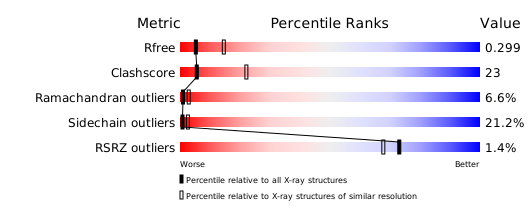
Structure validation
Download full validation report


