






 9P6S
9P6S
Cryo-EM structure of human integrin alpha5beta1 in complex with fibronectin (FN 7-10)
Summary for 9P6S
| Entry DOI | 10.2210/pdb9p6s/pdb |
| Related | 7nwl |
| EMDB information | 71324 |
| Descriptor | Integrin alpha-5, Integrin beta-1, Fibronectin, ... (10 entities in total) |
| Functional Keywords | a5b1 integrin, fibronectin, extracellular matrix, focal adhesion, single-particle, cell adhesion |
| Biological source | Homo sapiens (human) More |
| Total number of polymer chains | 3 |
| Total formula weight | 139275.72 |
| Authors | Ding, J.,Fantini, D.,Dedden, D.,Schumacher, S.,Biertumpfel, C.,Mizuno, N. (deposition date: 2025-06-19, release date: 2026-03-25) |
| Primary citation | Ding, J.,Fantini, D.A.,Dedden, D.,Schumacher, S.,Biertumpfel, C.,Mizuno, N. Allosteric regulation of fibronectin binding by the anti-beta 1 integrin antibody TS2/16. Pnas Nexus, 5:pgag044-pgag044, 2026 Cited by PubMed Abstract: The monoclonal antibody (mAb) TS2/16 stabilizes the active conformation of β1 integrin, enhancing its adhesive capacity on the cell surface. However, the molecular mechanism by which TS2/16 modulates integrin affinity for extracellular ligands remains unclear. Using endogenous full-length α5β1 integrin purified from human placenta, we determined the structure of integrin α5β1 with fibronectin up to 2.61-Å resolution in the absence of TS2/16, capturing the active form without its aid, and performed comparative B-factor-based analysis and CABS-Flex simulation with and without TS2/16. Despite no global conformational differences, we found that TS2/16 interacts with α2 helix of the integrin β1 subunit and contacts the C-terminus of α3 helix, leading to a localized decrease in B factor. This interaction allosterically alters the dynamics of α2-α3 loop despite not being in direct contact with TS2/16. Notably, this loop directly engages fibronectin, and its dynamic change underlies the enhanced ligand-binding affinity and explains increased cell adhesion observed with TS2/16. These findings reveal an allosteric mechanism of integrin regulation by TS2/16 and offer insights for the rational design of therapeutic antibodies targeting integrin-mediated adhesion in pathological contexts such as inflammation and cancer. PubMed: 41809771DOI: 10.1093/pnasnexus/pgag044 PDB entries with the same primary citation |
| Experimental method | ELECTRON MICROSCOPY (2.61 Å) |
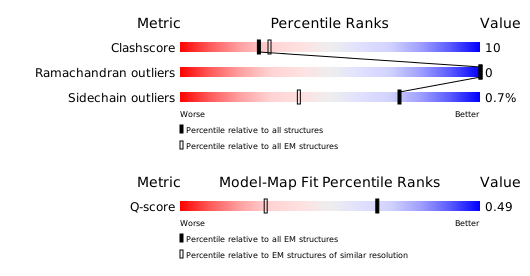
Structure validation
Download full validation report


