






 9OP3
9OP3
Structure of Human ADAR2-R2D complexed with dsRNA containing 8-azaN and 2'-Deoxy-2'-fluorouridine
Summary for 9OP3
| Entry DOI | 10.2210/pdb9op3/pdb |
| Descriptor | Double-stranded RNA-specific editase 1, RNA 32mer Top Strand, RNA 32mer 2F Bottom Strand, ... (8 entities in total) |
| Functional Keywords | adar, rna binding protein, rna binding protein-rna complex, rna binding protein/rna |
| Biological source | Homo sapiens (human) More |
| Total number of polymer chains | 4 |
| Total formula weight | 130170.80 |
| Authors | Campbell, K.B.,Ouye, R.B.,Wong, B.L.,Jiang, A.,Okada, K.,McKenney, R.J.,Fisher, A.J.,Beal, P.A. (deposition date: 2025-05-16, release date: 2025-10-08, Last modification date: 2025-12-03) |
| Primary citation | Campbell, K.B.,Ouye, R.B.,Wong, B.L.,Jiang, A.,Okada, K.,McKenney, R.J.,Fisher, A.J.,Beal, P.A. Control of ADAR2 Dimerization and RNA Editing Efficiency by Site-Specific 2'-Fluoro Modification of Guide RNAs. Acs Chem.Biol., 20:2637-2648, 2025 Cited by PubMed Abstract: Adenosine Deaminases Acting on RNA (ADARs) are an important class of RNA editing enzymes that catalyze the deamination of adenosine (A) to inosine (I) in double-stranded RNA (dsRNA). Since inosine is typically read as guanosine (G) during translation, ADARs can produce A to G transitions in dsRNA. Site-directed RNA editing (SDRE) is a promising therapeutic tool wherein guide RNAs can be used to direct endogenous human ADARs to reverse disease-causing mutations in specific RNA transcripts. Guide RNA (gRNA) modifications at locations that contact the ADAR active site are often used to improve editing efficiency. However, little is known about rate-enhancing chemical modifications in the gRNA at the dsRNA binding domain (dsRBD)-RNA interface. Analysis of published crystal structures of ADAR2 bound to dsRNA suggested positions at this interface would be sensitive to gRNA modification. In this work, gRNAs bearing 2'-modifications in the dsRBD binding site were synthesized and subsequently tested to determine their effects on the editing rate of therapeutically relevant ADAR targets. We found that replacing a single 2'-OH at specific positions on the gRNA with a 2'-F substantially increased the rate of ADAR2-catalyzed adenosine deamination for two different sequences, whereas 2'-OMe at these positions was inhibitory. This effect was also validated . The rate of ADAR1-catalyzed deamination is not stimulated by these 2'-F modifications. A crystal structure of an ADAR2 fragment bound to duplex RNA bearing a single 2'-F at guide position +13 suggested a favorable interaction between the side chain of N241 of the auxiliary ADAR2 monomer and the 2'-F modification. Furthermore, electrophoretic mobility shift assays and mass photometry indicate 2'-F at position +13 facilitates ADAR2 dimerization on the RNA substrate. This work advances our understanding of the RNA features that define superior ADAR substrates and inform the design of gRNAs for therapeutic RNA editing. PubMed: 41131871DOI: 10.1021/acschembio.5c00493 PDB entries with the same primary citation |
| Experimental method | X-RAY DIFFRACTION (2.59 Å) |
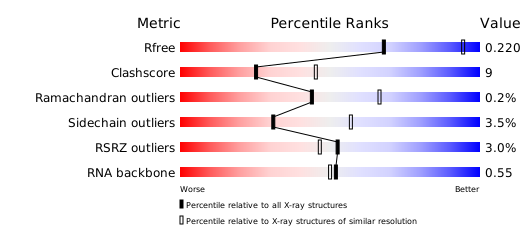
Structure validation
Download full validation report


