






 9NAB
9NAB
Cryo-EM structure of the alpha5beta1 integrin headpiece with OS2966 Fab
Summary for 9NAB
| Entry DOI | 10.2210/pdb9nab/pdb |
| EMDB information | 49184 |
| Descriptor | Integrin beta-1, Human Integrin alpha 5, IgG heavy chain, ... (4 entities in total) |
| Functional Keywords | integrin antibody, immune system |
| Biological source | Homo sapiens (human) More |
| Total number of polymer chains | 4 |
| Total formula weight | 178580.37 |
| Authors | |
| Primary citation | Song, N.,Chen, S.,Wang, L.,Dang, J.,Cao, X.,Singh, S.,Yang, L.,Wang, J.,Rosen, S.T.,Wang, Y.,Chen, C.D.,Zhang, C.,Feng, M. ITGB1 Regulates Triple-Negative Breast Cancer Development by Modulating the Tumor Microenvironment. Adv Sci, 13:e13672-e13672, 2026 Cited by PubMed Abstract: Tumorigenesis and metastasis are frequently attributed to the intricate interplay between cancer cells and the tumor microenvironment (TME). Comprehending the mechanisms and key regulators of cancer-immune crosstalk in the TME is imperative for developing efficacious immunotherapy. Through a series of in vivo CRISPR screens, we identified tumor-intrinsic ITGB1 as a critical regulator of triple-negative breast cancer (TNBC) development and deciphered its underlying mechanisms. Tumoral ITGB1 facilitated the establishment of pro-tumorigenic TME by orchestrating tumor-associated myeloid populations. Suppressing ITGB1 favored the enrichment of anti-tumorigenic myeloid cells and enhanced infiltration of CD4 and CD8 T cells, culminating in superior antitumor effects. CRISPR scanning pinpointed a previously unrecognized functional domain essential for ITGB1's pro-tumorigenic activity. This domain is distinct from all known ligand-binding sites in ITGB1. An antibody capable of sterically blocking this domain significantly impaired TNBC progression. These findings position tumoral ITGB1 as a promising therapeutic target for reprogramming the TME from a pro- to an anti-tumorigenic state, thereby effectively inhibiting TNBC development. Our study uncovers a novel mechanism of TNBC development and provides a unique therapeutic strategy for targeting ITGB1 in TNBC treatment. PubMed: 41632816DOI: 10.1002/advs.202513672 PDB entries with the same primary citation |
| Experimental method | ELECTRON MICROSCOPY (2.54 Å) |
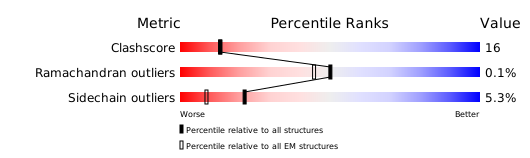
Structure validation
Download full validation report


