






 9N1Z
9N1Z
Structure of C3d Bound to a Fragment of FHR-2
Summary for 9N1Z
| Entry DOI | 10.2210/pdb9n1z/pdb |
| Descriptor | Complement C3dg fragment, Complement factor H-related protein 2, SULFATE ION, ... (4 entities in total) |
| Functional Keywords | complement system, c3, rca, inhibitor, immune system |
| Biological source | Homo sapiens (human) More |
| Total number of polymer chains | 4 |
| Total formula weight | 95997.02 |
| Authors | Duan, H.,Geisbrecht, B.V. (deposition date: 2025-01-27, release date: 2025-12-10, Last modification date: 2026-04-08) |
| Primary citation | Duan, H.,Kortvely, E.,Mary, J.L.,Hauck, S.M.,Geisbrecht, B.V. The C-terminal domain of Staphylococcus aureus Efb recruits FHR-2 to C3b, synergistically inhibiting the terminal complement pathway. J Immunol., 215:-, 2026 Cited by PubMed Abstract: The extracellular fibrinogen-binding protein (Efb) is one of nearly a dozen proteins secreted by Staphylococcus aureus to inhibit complement activation or amplification. The C-terminal domain of Efb (Efb-C) forms a high-affinity interaction with the thioester-containing domain of C3b (TED/C3d), thereby blocking formation of the C3 proconvertase complex through an allosteric mechanism. However, further functional consequences of Efb-C binding to C3b remain unexplored. Here, we identified a previously unknown interaction between Efb-C, C3b, and the complement regulatory molecule FHR2 (factor H-related protein 2). Since the FHR2/C3b interaction is centered upon the 2 C-terminal-most domains of FHR2 (FHR2[3-4]) and the TED/C3d domain of C3b, we tested whether Efb-C could influence the FHR2(3-4)/C3d interaction. We observed a significant enhancement of FHR2(3-4)/C3d binding in the presence of Efb-C. We studied the FHR2(3-4)/C3d/Efb-C complex by X-ray crystallography and found that Efb-C forms few direct interactions with FHR2(3-4). Yet, the presence of Efb-C also enhanced binding of FHR2(3-4) and full-length FHR2 to C3b, suggesting that the effect of Efb-C on the FHR2/C3b interaction arises from increased accessibility of the FHR2-binding site. We found that enhanced FHR2 binding did not impact the rate of C3 convertase formation more than Efb-C alone, nor did it impart decay acceleration or cofactor activity. However, we observed potent, synergistic inhibition of complement downstream of C5 activation by Efb-C and FHR2 but not by Efb-C and FHR2(3-4). Our results show that Efb-C binding to C3b exerts additional inhibitory effects on the central complement components beyond blocking formation of the C3 proconvertase alone. PubMed: 41273729DOI: 10.1093/jimmun/vkaf316 PDB entries with the same primary citation |
| Experimental method | X-RAY DIFFRACTION (2.31 Å) |
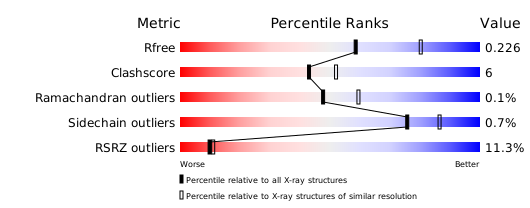
Structure validation
Download full validation report


