






 9K0I
9K0ISummary for 9K0I
| Entry DOI | 10.2210/pdb9k0i/pdb |
| Descriptor | Fibroblast growth factor receptor 4, (2~{S})-~{N}-[2-[[5-[(1~{R})-1-[3,5-bis(chloranyl)pyridin-4-yl]ethoxy]-1~{H}-indazol-3-yl]amino]-3-fluoranyl-5-(4-morpholin-4-ylpiperidin-1-yl)phenyl]-2-cyano-3-cyclopropyl-propanamide, SULFATE ION, ... (4 entities in total) |
| Functional Keywords | kinase, inhibitor, structural protein, transferase-transferase inhibitor complex, transferase |
| Biological source | Homo sapiens (human) |
| Total number of polymer chains | 1 |
| Total formula weight | 36057.08 |
| Authors | Chen, X.J.,Chen, Y.H. (deposition date: 2024-10-15, release date: 2025-10-22, Last modification date: 2026-05-06) |
| Primary citation | Guo, J.,Chen, X.,Li, X.,Wang, X.,Shao, M.,Song, X.,Zhang, L.,Huang, S.,Patterson, A.V.,Smaill, J.B.,Zhou, Y.,Yu, X.,Chen, Y.,Lu, X. Optimization of Aminoindazole derivatives as highly selective covalent inhibitors for wild-type and mutant FGFR4. Bioorg.Chem., 160:108469-108469, 2025 Cited by PubMed Abstract: The Fibroblast growth factor receptor 4 (FGFR4) has emerged as a potential oncogenic driver in hepatocellular carcinoma (HCC), primarily due to aberrations in the FGFR4-FGF19 signaling axis. Although the FGFR4-selective inhibitors have been reported, none have received approval. Further, the clinical acquired resistance caused by FGFR4 mutations has become an unmet clinical need for cancer therapy. In this study, we designed and synthesized a series of 3-amido-1H-indazole-based FGFR4 irreversible inhibitors, targeting both wild-type FGFR4 and the gatekeeper and molecular brake mutants. The representative compound, 48c, exhibited potent inhibitory activity against FGFR4 kinase (IC = 2.9 nM) and picomolar activity against FGFR4, FGFR4, and FGFR4-driven Ba/F3 cell lines (IC < 0.1, 0.3, and 0.3 nM, respectively). 48c exhibited high selectivity across a panel of 66 kinases harboring a cysteine at the hinge region, highlighting its potential as a promising therapeutic candidate for overcoming resistance in FGFR4-associated tumors. PubMed: 40252369DOI: 10.1016/j.bioorg.2025.108469 PDB entries with the same primary citation |
| Experimental method | X-RAY DIFFRACTION (2.236 Å) |
Structure validation
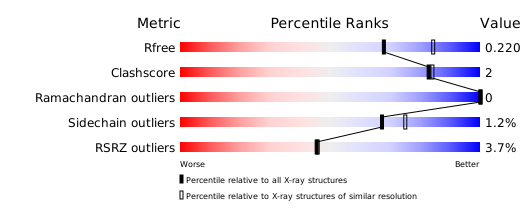
Download full validation report


