






 9GSU
9GSU
Structure of PP1-Neurabin bound to 4E-BP1.
Summary for 9GSU
| Entry DOI | 10.2210/pdb9gsu/pdb |
| Descriptor | Serine/threonine-protein phosphatase, Neurabin-1, MANGANESE (II) ION, ... (4 entities in total) |
| Functional Keywords | pp1, neurabin, 4ebp1, hydrolase |
| Biological source | Homo sapiens (human) More |
| Total number of polymer chains | 4 |
| Total formula weight | 115365.58 |
| Authors | Mouilleron, S.,Treisman, R.,Fedoryshchak, R.,Elbouri, K. (deposition date: 2024-09-16, release date: 2025-06-18, Last modification date: 2026-01-14) |
| Primary citation | Fedoryshchak, R.O.,El-Bouri, K.,Joshi, D.,Mouilleron, S.,Treisman, R. PDZ-directed substrate recruitment is the primary determinant of specific 4E-BP1 dephosphorylation by PP1-Neurabin. Elife, 13:-, 2025 Cited by PubMed Abstract: Phosphoprotein phosphatase 1 (PP1) relies on association with PP1-interacting proteins (PIPs) to generate substrate-specific PIP/PP1 holoenzymes, but the lack of well-defined substrates has hindered elucidation of the mechanisms involved. We previously demonstrated that the Phactr1 PIP confers sequence specificity on the Phactr1/PP1 holoenzyme by remodelling the PP1 hydrophobic substrate groove. Phactr1 defines a group of 'RVxF-ΦΦ-R-W' PIPs that all interact with PP1 in a similar fashion. Here, we use a PP1-PIP fusion approach to address sequence specificity and identify substrates of the RVxF-ΦΦ-R-W family PIPs. We show that the four Phactr proteins confer identical sequence specificities on their holoenzymes. We identify the 4E-BP and p70 S6K translational regulators as substrates for the Neurabin/Spinophilin PIPs, implicated in neuronal plasticity, pointing to a role for their holoenzymes in mTORC1-dependent translational control. Biochemical and structural experiments show that in contrast to the Phactrs, substrate recruitment and catalytic efficiency of the PP1-Neurabin and PP1-Spinophilin fusions is primarily determined by substrate interaction with the PDZ domain adjoining their RVxF-ΦΦ-R-W motifs, rather than by recognition of the remodelled PP1 hydrophobic groove. Thus, even PIPs that interact with PP1 in a similar manner use different mechanisms to ensure substrate selectivity. PubMed: 40548551DOI: 10.7554/eLife.103403 PDB entries with the same primary citation |
| Experimental method | X-RAY DIFFRACTION (2.36 Å) |
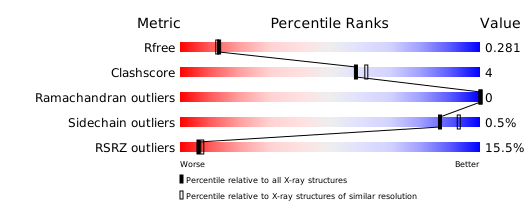
Structure validation
Download full validation report


