






 9FZR
9FZR
Wild-type EGFR in covalent complex with Poziotinib analogue
This is a non-PDB format compatible entry.
Summary for 9FZR
| Entry DOI | 10.2210/pdb9fzr/pdb |
| Descriptor | Epidermal growth factor receptor, 1-[(3~{S})-3-[4-[(3-chloranyl-4-fluoranyl-phenyl)amino]-7-methoxy-quinazolin-6-yl]oxypyrrolidin-1-yl]propan-1-one (3 entities in total) |
| Functional Keywords | egfr, covalent, poziotinib, transferase |
| Biological source | Homo sapiens (human) |
| Total number of polymer chains | 1 |
| Total formula weight | 37903.19 |
| Authors | Anthony, N.,Pintar, S.,Noble, M.E.N.,Martin, M.P. (deposition date: 2024-07-05, release date: 2025-07-16, Last modification date: 2026-01-28) |
| Primary citation | Morese, P.A.,Ahmad, A.,Martin, M.P.,Noble, R.A.,Pintar, S.,Wang, L.Z.,Xu, S.,Lister, A.,Ward, R.A.,Bronowska, A.K.,Noble, M.E.M.,Stewart, H.L.,Waring, M.J. Factors affecting irreversible inhibition of EGFR and influence of chirality on covalent binding. Commun Chem, 8:111-111, 2025 Cited by PubMed Abstract: The discovery of targeted covalent inhibitors is of increasing importance in drug discovery. Finding efficient covalent binders requires modulation of warhead reactivity and optimisation of warhead geometry and non-covalent interactions. Uncoupling the contributions that these factors make to potency is difficult and best practice for a testing cascade that is pragmatic and informative is yet to be fully established. We studied the structure-reactivity-activity relationships of a series of analogues of the EGFR inhibitor poziotinib with point changes in two substructural regions as well as variations in warhead reactivity and geometry. This showed that a simple probe displacement assay that is appropriately tuned in respect of timing and reagent concentrations can reveal structural effects on all three factors: non-covalent affinity, warhead reactivity and geometry. These effects include the detection of potency differences between an enantiomeric pair that differ greatly in their activity and their capacity to form a covalent bond. This difference is rationalised by X-ray crystallography and computational studies and the effect translates quantitatively into cellular mechanistic and phenotypic effects. PubMed: 40204983DOI: 10.1038/s42004-025-01501-6 PDB entries with the same primary citation |
| Experimental method | X-RAY DIFFRACTION (1.991 Å) |
Structure validation
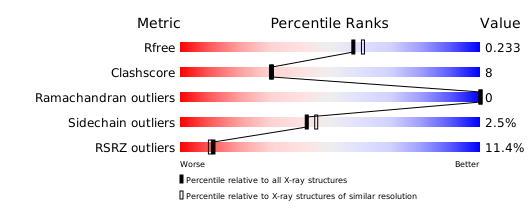
Download full validation report


