






 9EK5
9EK5
TRIM21 PrySpry domain bound to an enhanced PRLX-93936 analog
This is a non-PDB format compatible entry.
Summary for 9EK5
| Entry DOI | 10.2210/pdb9ek5/pdb |
| Descriptor | E3 ubiquitin-protein ligase TRIM21, (3P)-3-(4-chloro-2-ethoxyphenyl)-6-fluoro-2-[(piperazin-1-yl)methyl]quinazolin-4(3H)-one (3 entities in total) |
| Functional Keywords | trim21, ubiquitin, ubiquitin ligase, small molecule, protein degradation, innate immunity, cancer, therapeutics, immune system |
| Biological source | Homo sapiens (human) |
| Total number of polymer chains | 1 |
| Total formula weight | 20922.86 |
| Authors | Hinshaw, S.M.,Corsello, S.M.,Yuan, L.,Lu, J.,Martinez, M.,Gray, N.S. (deposition date: 2024-11-30, release date: 2025-08-27, Last modification date: 2026-03-11) |
| Primary citation | Yuan, L.,Ji, W.,Dwyer, B.G.,Lu, J.,Bian, J.,Colombo, G.M.,Martinez, M.J.,Fernandez, D.,Phillips, N.A.,Tang, M.T.,Zhou, C.W.,Quispe Calla, N.E.,Guzman Huancas, C.,Eckart, M.,Tran, J.,Jones, H.M.,Qiu, T.,Doench, J.G.,Rees, M.G.,Roth, J.A.,Cameron, M.D.,Charville, G.W.,Kuo, C.J.,Dixon, S.J.,Zhang, T.,Hinshaw, S.M.,Gray, N.S.,Corsello, S.M. Defining the Antitumor Mechanism of Action of a Clinical-stage Compound as a Selective Degrader of the Nuclear Pore Complex. Cancer Discov, 15:2505-2529, 2025 Cited by PubMed Abstract: Cancer cells are acutely dependent on nuclear transport due to elevated transcriptional activity, suggesting an unrealized opportunity for selective therapeutic inhibition of the nuclear pore complex (NPC). Through large-scale phenotypic profiling of cancer cell lines, genome-scale functional genomic modifier screens, and mass spectrometry-based proteomics, we discovered that the clinical drug PRLX-93936 is a molecular glue that binds and reprograms the TRIM21 ubiquitin ligase to degrade the NPC. Upon compound-induced TRIM21 recruitment, the nuclear pore is ubiquitylated and degraded, resulting in the loss of short-lived cytoplasmic mRNA transcripts and the induction of cancer cell apoptosis. Direct compound binding to TRIM21 was confirmed via surface plasmon resonance and X-ray crystallography, whereas compound-induced TRIM21-nucleoporin complex formation was demonstrated through multiple orthogonal approaches in cells and in vitro. Phenotype-guided optimization yielded compounds with 10-fold greater potency and drug-like properties, along with robust pharmacokinetics and efficacy against pancreatic cancer xenografts and patient-derived organoids. PubMed: 40891634DOI: 10.1158/2159-8290.CD-25-0271 PDB entries with the same primary citation |
| Experimental method | X-RAY DIFFRACTION (2.1 Å) |
Structure validation
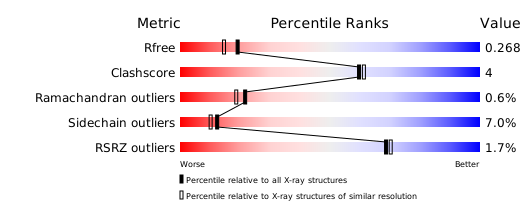
Download full validation report


