






 9DVT
9DVT
Cryo-EM structure of RpaA bound to PkaiBC DNA and the CTD of the alpha subunit of RNAP from the cyanobacterium Synechococcus elongatus
Summary for 9DVT
| Entry DOI | 10.2210/pdb9dvt/pdb |
| EMDB information | 47222 |
| Descriptor | Non-template DNA, Template DNA, DNA-directed RNA polymerase subunit alpha, ... (5 entities in total) |
| Functional Keywords | alpha subunit of rnap, pkaibc dna, rpaa, transcription factor, dna binding protein, dna binding protein-dna complex, dna binding protein/dna |
| Biological source | Synechococcus elongatus More |
| Total number of polymer chains | 6 |
| Total formula weight | 201538.06 |
| Authors | Fang, M.,Gu, Y.,Matyszewski, M.,Leanca, M.,LiWang, A.,Yuzenkova, Y.,Corbett, K.D.,Golden, S.E. (deposition date: 2024-10-08, release date: 2025-10-15, Last modification date: 2026-05-27) |
| Primary citation | Fang, M.,Gu, Y.,Leanca, M.,Matyszewski, M.,LiWang, A.,Yuzenkova, Y.,Corbett, K.D.,Golden, S.S. Mechanism and reconstitution of circadian transcription in cyanobacteria. Nat.Struct.Mol.Biol., 33:275-281, 2026 Cited by PubMed Abstract: Circadian biological clocks evolved across kingdoms of life as an adaptation to predictable cycles of sunrise and sunset. In the cyanobacterium Synechococcus elongatus, a protein-based clock precisely controls when different genes are turned on and off during the 24-h day but the phasing mechanism remains unclear. Here we show the molecular basis of this regulation and reconstitute clock-controlled transcription in vitro using purified components. Biochemical and structural analyses revealed that the clock-regulated transcription factor RpaA can function as either an activator or a repressor of cyanobacterial RNA polymerase, depending on its binding position relative to core promoter elements. Leveraging the repressor mechanism, we developed a heterologous in vitro system driven by bacteriophage T7 RNA polymerase that sustains circadian transcription for multiple days. These findings explain how a single clock output generates opposite phases of gene expression and define the minimal components for circadian clock function, enabling synthetic or biotechnological applications. PubMed: 41667880DOI: 10.1038/s41594-025-01740-0 PDB entries with the same primary citation |
| Experimental method | ELECTRON MICROSCOPY (3.74 Å) |
Structure validation
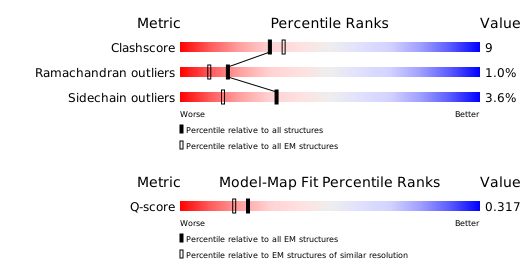
Download full validation report


