






 8ZCA
8ZCA
Crystal structure of human CD47 ECD bound to Fab of Hu1C8
Summary for 8ZCA
| Entry DOI | 10.2210/pdb8zca/pdb |
| Descriptor | 1C8 Fab light chain, 1C8 Fab heavy chain, Leukocyte surface antigen CD47, ... (7 entities in total) |
| Functional Keywords | cd47, antibody, immune system |
| Biological source | Homo sapiens (human) More |
| Total number of polymer chains | 6 |
| Total formula weight | 126122.35 |
| Authors | |
| Primary citation | Lu, X.,Chen, Z.,Yi, C.,Ling, Z.,Ye, J.,Chen, K.,Cong, Y.,Sonam, W.,Cheng, S.,Wang, R.,Zhang, D.,Xu, J.,Yang, J.,Ma, L.,Duan, Q.,Sun, X.,Ding, J.,Sun, B. An anti-CD47 antibody binds to a distinct epitope in a novel metal ion-dependent manner to minimize cross-linking of red blood cells. J.Biol.Chem., 301:110420-110420, 2025 Cited by PubMed Abstract: Cluster of differentiation 47 (CD47) is a widely expressed transmembrane protein that plays a crucial role in immune self-recognition. Cancer cells upregulate CD47 expression to promote immune escape through activating the "don't eat me" signal via interactions with signal regulatory protein α (SIRPα) on macrophages. The effectiveness of anti-CD47 antibodies has been demonstrated in multiple tumor models. However, since CD47 is also expressed in human red blood cells (RBCs) and platelets, the clinical application of anti-CD47 antibodies requires careful consideration of blood toxicity. One major obstacle to the clinical application of CD47 antibodies is the hemagglutination caused by RBCs cross-linking. In this study, we generated Hu1C8, a humanized anti-CD47 monoclonal antibody that demonstrated increased selectivity for binding to CD47 on cancer cells and lacked hemagglutination activity. Epitope mapping and the crystal structure of the Hu1C8 Fab-CD47 extracellular domain (ECD) complex revealed that Hu1C8 binds to a distinct epitope of CD47 in a Ca-dependent manner. The unique recognition and binding mode allowed Hu1C8 to bind CD47 on RBCs with reduced hemagglutination activity while still maintaining effective antitumor activity. These findings demonstrate a feasible strategy for developing CD47 antibodies with high antitumor activity but low RBC hemagglutination activity. Our study elucidates how epitope-specific antibody influences antibody-induced cell cross-linking, offering innovative strategies for antibody design to either leverage or avoid cell cross-linking effects. PubMed: 40578556DOI: 10.1016/j.jbc.2025.110420 PDB entries with the same primary citation |
| Experimental method | X-RAY DIFFRACTION (2.5 Å) |
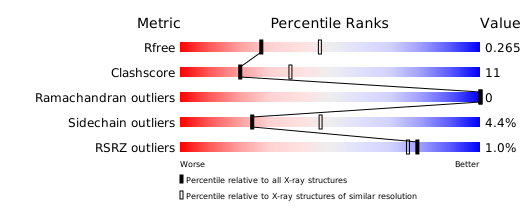
Structure validation
Download full validation report


