






 8YAT
8YAT
SOD1, Nanobody1, Nanobody2 and Nanobody3 complex
Summary for 8YAT
| Entry DOI | 10.2210/pdb8yat/pdb |
| Descriptor | Superoxide dismutase [Cu-Zn], NB1, NB2, ... (5 entities in total) |
| Functional Keywords | antibody complex, oxidoreductase, oxidoreductase/immune system, oxidoreductase-immune system complex |
| Biological source | Homo sapiens (human) More |
| Total number of polymer chains | 16 |
| Total formula weight | 225222.48 |
| Authors | Cheng, S. (deposition date: 2024-02-10, release date: 2025-02-12, Last modification date: 2026-01-28) |
| Primary citation | Cheng, S.,Zhong, C.,Zhu, H.,Mu, K.,Jiang, H.,Zhong, P.,Ma, Z.,Liu, X.,Wang, Z.,Liu, R.,Ding, Y. Structural mechanisms and insights on multiple nanobodies binding diverse SOD1 epitopes. Commun Biol, 9:30-30, 2025 Cited by PubMed Abstract: Copper/zinc superoxide dismutase (SOD1) is a crucial metalloenzyme that mitigates oxidative stress by scavenging superoxide anion radicals. Mutations and aggregation of SOD1 are closely linked to the pathogenesis of amyotrophic lateral sclerosis (ALS). Targeting pathogenic SOD1 with nanobodies presents a promising therapeutic approach. We report the first high-resolution crystal structures of SOD1 in complex with three distinct nanobodies (Nb1, Nb2, and Nb3) and their multimeric assemblies (1:2 and 1:3 stoichiometries), revealing distinct binding epitopes primarily mediated by their complementarity determining regions (CDRs) through hydrogen bonds, salt bridges, and hydrophobic interactions. Structural and biophysical analyses using isothermal titration calorimetry (ITC) and fluorescence-detection size-exclusion chromatography (FSEC) demonstrated that all three nanobodies bind SOD1 simultaneously with nanomolar affinities (K values ranging from 23.2 nM to 529 nM). Notably, engineered multimeric tandem nanobodies (Nb1-Nb2-Nb3) achieved higher affinity (K = 4.39 nM) compared to single nanobodies, as validated by ITC. Characterization via dynamic light scattering (DLS) further revealed colloidal stability of SOD1-nanobody complexes. These results provide the first atomic-resolution insights into multi-nanobody targeting of SOD1 without steric interference, establishing a foundation for developing high-affinity tools to detect and manipulate SOD1 in ALS and related neurodegenerative diseases. PubMed: 41350409DOI: 10.1038/s42003-025-09293-0 PDB entries with the same primary citation |
| Experimental method | X-RAY DIFFRACTION (3.94 Å) |
Structure validation
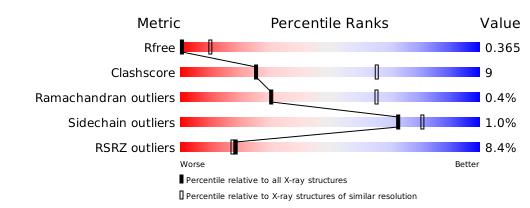
Download full validation report


