






 8VY2
8VY2
Structure of mCELSR1 extracellular region containing CADH9-GAIN domains
Summary for 8VY2
| Entry DOI | 10.2210/pdb8vy2/pdb |
| EMDB information | 43644 |
| Descriptor | Cadherin EGF LAG seven-pass G-type receptor 1, 2-acetamido-2-deoxy-beta-D-glucopyranose-(1-4)-2-acetamido-2-deoxy-beta-D-glucopyranose, beta-D-mannopyranose-(1-4)-2-acetamido-2-deoxy-beta-D-glucopyranose-(1-4)-2-acetamido-2-deoxy-beta-D-glucopyranose, ... (4 entities in total) |
| Functional Keywords | celsr, adhesion, gpcr, planar cell polarity, signaling protein |
| Biological source | Mus musculus (house mouse) |
| Total number of polymer chains | 1 |
| Total formula weight | 248825.27 |
| Authors | Bandekar, S.J.,Arac, D. (deposition date: 2024-02-06, release date: 2025-05-07, Last modification date: 2025-08-20) |
| Primary citation | Bandekar, S.J.,Garbett, K.,Kordon, S.P.,Dintzner, E.E.,Li, J.,Shearer, T.,Sando, R.C.,Arac, D. Structural basis for regulation of CELSR1 by a compact module in its extracellular region. Nat Commun, 16:3972-3972, 2025 Cited by PubMed Abstract: The Cadherin EGF Laminin G seven-pass G-type receptor subfamily (CELSR/ADGRC) is one of the most conserved among adhesion G protein-coupled receptors and is essential for animal development. The extracellular regions (ECRs) of CELSRs are large with 23 adhesion domains. However, molecular insight into CELSR function is sparsely available. Here, we report the 3.8 Å cryo-EM reconstruction of the mouse CELSR1 ECR and reveal that 14 domains form a compact module mediated by conserved interactions majorly between the CADH9 and C-terminal GAIN domains. In the presence of Ca, the CELSR1 ECR forms a dimer species mediated by the cadherin repeats putatively in an antiparallel fashion. Cell-based assays reveal the N-terminal CADH1-8 repeat is required for cell-cell adhesion and the C-terminal CADH9-GAIN compact module can regulate cellular adhesion. Our work provides molecular insight into how one of the largest GPCRs uses defined structural modules to regulate receptor function. PubMed: 40295529DOI: 10.1038/s41467-025-59319-8 PDB entries with the same primary citation |
| Experimental method | ELECTRON MICROSCOPY (4.3 Å) |
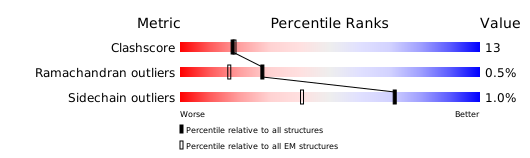
Structure validation
Download full validation report


