






 8TMU
8TMU
HLA-B*73:01 bound to a 10mer peptide in complex with KIR2DL2
Summary for 8TMU
| Entry DOI | 10.2210/pdb8tmu/pdb |
| Descriptor | HLA-B*73:01, Beta-2-microglobulin, Killer cell immunoglobulin-like receptor 2DL2, ... (8 entities in total) |
| Functional Keywords | hla, mhc, kir, class i, immune system |
| Biological source | Homo sapiens (human) More |
| Total number of polymer chains | 4 |
| Total formula weight | 70687.45 |
| Authors | |
| Primary citation | Ross, P.,Hilton, H.G.,Lodwick, J.,Slezak, T.,Guethlein, L.A.,McMurtrey, C.P.,Han, A.S.,Nielsen, M.,Yong, D.,Dulberger, C.L.,Nolan, K.T.,Roy, S.,Castro, C.D.,Hildebrand, W.H.,Zhao, M.,Kossiakoff, A.,Parham, P.,Adams, E.J. Molecular characterization of the archaic HLA-B∗73:01 allele reveals presentation of a unique peptidome and skewed engagement by KIR2DL2. J.Biol.Chem., 301:110542-110542, 2025 Cited by PubMed Abstract: HLA class I alleles of archaic origin may have been retained in modern humans because they provide immunity against diseases to which archaic humans had evolved resistance. According to this model, archaic introgressed alleles were somehow distinct from those that evolved in African populations. Here, we show that HLA-B∗73:01, a rare allotype with putative archaic origins, has a relatively rare peptide binding motif with an unusually long-tailed peptide length distribution. We also find that HLA-B∗73:01 combines a restricted and unique peptidome with high-cell surface expression, characteristics that make it well-suited to combat one or a number of closely related pathogens. Furthermore, a crystal structure of HLA-B∗73:01 in complex with KIR2DL2 highlights differences from previously solved structures with HLA-C molecules. These molecular characteristics distinguish HLA-B∗73:01 from other HLA class I alleles previously investigated and may have provided early modern human migrants that inherited this allele with a selective advantage as they colonized Europe and Asia. PubMed: 40749828DOI: 10.1016/j.jbc.2025.110542 PDB entries with the same primary citation |
| Experimental method | X-RAY DIFFRACTION (2.9 Å) |
Structure validation
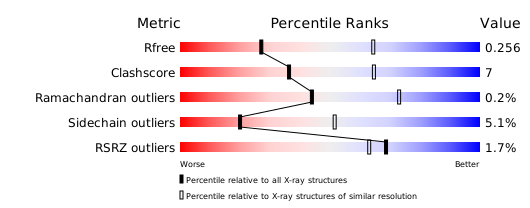
Download full validation report


