






 8S7O
8S7O
M. tuberculosis gyrase holocomplex with 150 bp DNA and BDM71403
This is a non-PDB format compatible entry.
Summary for 8S7O
| Entry DOI | 10.2210/pdb8s7o/pdb |
| Related | 8S7K |
| EMDB information | 19782 |
| Descriptor | DNA gyrase subunit A, DNA gyrase subunit B, DNA (5'-D(*CP*CP*GP*GP*AP*AP*GP*GP*GP*GP*TP*AP*AP*TP*AP*CP*T)-3'), ... (5 entities in total) |
| Functional Keywords | mycobacterium tuberculosis, dna gyrase, novel bacterial topoisomerase ii inhibitors, antibiotic resistance, structure-activity relation, dna binding protein |
| Biological source | Mycobacterium tuberculosis More |
| Total number of polymer chains | 6 |
| Total formula weight | 426520.63 |
| Authors | Gedeon, A.,Yab, E.,Dinut, A.,Sadowski, E.,Capton, E.,Dreneau, A.,Gioia, B.,Piveteau, C.,Djaout, K.,Lecat, E.,Wehenkel, A.M.,Gubellini, F.,Mechaly, A.,Alzari, P.M.,Deprez, B.,Baulard, A.,Aubry, A.,Willand, N.,Petrella, S. (deposition date: 2024-03-04, release date: 2025-03-19, Last modification date: 2026-05-13) |
| Primary citation | Gedeon, A.,Yab, E.,Dinut, A.,Sadowski, E.,Capton, E.,Dreneau, A.,Petit, J.,Gioia, B.,Piveteau, C.,Djaout, K.,Lecat, E.,Wehenkel, A.M.,Gubellini, F.,Mechaly, A.,Alzari, P.M.,Deprez, B.,Baulard, A.,Aubry, A.,Willand, N.,Petrella, S. Molecular mechanism of a triazole-containing inhibitor of Mycobacterium tuberculosis DNA gyrase. Iscience, 27:110967-110967, 2024 Cited by PubMed Abstract: Antimicrobial resistance remains a persistent and pressing public health concern. Here, we describe the synthesis of original triazole-containing inhibitors targeting the DNA gyrase, a well-validated drug target for developing new antibiotics. Our compounds demonstrate potent antibacterial activity against various pathogenic bacteria, with notable potency against (). Moreover, one hit, compound , named BDM71403, was shown to be more potent in than the NBTI of reference, gepotidacin. Mechanistic enzymology assays reveal a competitive interaction of BDM71403 with fluoroquinolones within the gyrase cleavage core. High-resolution cryo-electron microscopy structural analysis provides detailed insights into the ternary complex formed by the gyrase, double-stranded DNA, and either BDM71403 or gepotidacin, providing a rational framework to understand the superior efficacy on . This study highlights the potential of triazole-based scaffolds as promising gyrase inhibitors, offering new avenues for drug development in the fight against antimicrobial resistance. PubMed: 39429773DOI: 10.1016/j.isci.2024.110967 PDB entries with the same primary citation |
| Experimental method | ELECTRON MICROSCOPY (2.8 Å) |
Structure validation
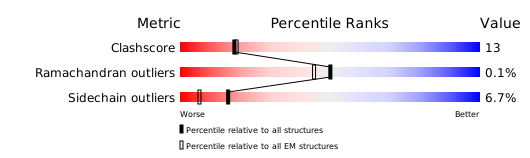
Download full validation report


