






 8QDE
8QDE
Crystal structure of a truncated human L-Lactate Dehydrogenase B protein in complex with NADH and oxamate
Summary for 8QDE
| Entry DOI | 10.2210/pdb8qde/pdb |
| Descriptor | L-lactate dehydrogenase B chain, 1,4-DIHYDRONICOTINAMIDE ADENINE DINUCLEOTIDE, OXAMIC ACID, ... (7 entities in total) |
| Functional Keywords | complex, truncated protein, oxidoreductase |
| Biological source | Homo sapiens (human) |
| Total number of polymer chains | 4 |
| Total formula weight | 150683.67 |
| Authors | Van Gysel, M.,Wouters, J. (deposition date: 2023-08-29, release date: 2024-09-11, Last modification date: 2025-12-17) |
| Primary citation | Nadal-Bufi, F.,Van Gysel, M.,Brustenga, C.,Savoyen, P.,Mathieu, C.,Gobert, A.,Sonveaux, P.,Spillier, Q.,Fillet, M.,Wouters, J.,Frederick, R. Unveiling the enzymatic activity of a dimeric LDH isoform and its implications for allosteric inhibition strategies. Protein Sci., 34:e70367-e70367, 2025 Cited by PubMed Abstract: Lactate dehydrogenase (LDH) is a key enzyme in cancer metabolism, with isoforms LDH5 and LDH1 supporting glycolysis and oxidative lactate metabolism, respectively. While the development of competitive LDH inhibitors has faced diverse challenges, allosteric strategies targeting LDH tetramerization have recently attracted increasing attention. To further explore this alternative, we investigated the factors influencing LDH tetramerization and enzymatic activity using a truncated form of human LDH-B (LDHBtr), which was reported to exist predominantly as a dimer. Unexpectedly, LDHBtr exhibited measurable activity at high concentrations, correlating with increased protein stability and a structural transition to the tetrameric form. Preincubation with NADH further enhanced LDHBtr activity, stability, and self-association, consistent with cofactor-promoted tetramer assembly. Crystallographic studies confirmed the tetrameric structure of LDHBtr bound to NADH. Furthermore, reported LDH allosteric inhibitors, including cGmC9 and fluoxetine, preferentially inhibited LDHBtr compared to the native LDHB, by preventing tetramer formation. Overall, this work highlights the central role of tetramerization in regulating LDH activity, and the therapeutic potential of targeting this process. It also establishes LDHBtr as a valuable tool for screening tetramerization disruptors, paving the way for next-generation LDH inhibitors to target cancer metabolism. PubMed: 41229320DOI: 10.1002/pro.70367 PDB entries with the same primary citation |
| Experimental method | X-RAY DIFFRACTION (2.98 Å) |
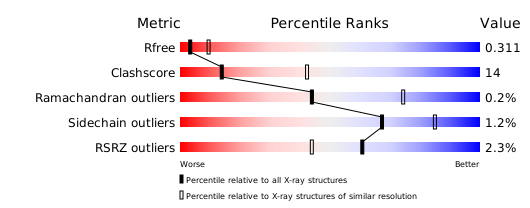
Structure validation
Download full validation report


