






 4QDS
4QDS
Physical basis for Nrp2 ligand binding
Summary for 4QDS
| Entry DOI | 10.2210/pdb4qds/pdb |
| Related | 4QDQ 4QDR |
| Descriptor | Neuropilin-2, GLYCEROL, ACETATE ION, ... (4 entities in total) |
| Functional Keywords | coagulation factor domain, discoidin domain, receptor, vegf-c, secreted, cell adhesion |
| Biological source | Homo sapiens (human) |
| Cellular location | Membrane; Single-pass type I membrane protein. Isoform s9: Secreted : O60462 |
| Total number of polymer chains | 2 |
| Total formula weight | 42018.06 |
| Authors | Parker, M.W.,Vander Kooi, C.W. (deposition date: 2014-05-14, release date: 2015-04-15, Last modification date: 2024-11-20) |
| Primary citation | Parker, M.W.,Linkugel, A.D.,Goel, H.L.,Wu, T.,Mercurio, A.M.,Vander Kooi, C.W. Structural Basis for VEGF-C Binding to Neuropilin-2 and Sequestration by a Soluble Splice Form. Structure, 23:677-687, 2015 Cited by PubMed Abstract: Vascular endothelial growth factor C (VEGF-C) is a potent lymphangiogenic cytokine that signals via the coordinated action of two cell surface receptors, Neuropilin-2 (Nrp2) and VEGFR-3. Diseases associated with both loss and gain of VEGF-C function, lymphedema and cancer, respectively, motivate studies of VEGF-C/Nrp2 binding and inhibition. Here, we demonstrate that VEGF-C binding to Nrp2 is regulated by C-terminal proteolytic maturation. The structure of the VEGF-C C terminus in complex with the ligand binding domains of Nrp2 demonstrates that a cryptic Nrp2 binding motif is released upon proteolysis, allowing specific engagement with the b1 domain of Nrp2. Based on the identified structural requirements for Nrp2 binding to VEGF-C, we hypothesized that the endogenous secreted splice form of Nrp2, s9Nrp2, may function as a selective inhibitor of VEGF-C. We find that s9Nrp2 forms a stable dimer that potently inhibits VEGF-C/Nrp2 binding and cellular signaling. These data provide critical insight into VEGF-C/Nrp2 binding and inhibition. PubMed: 25752543DOI: 10.1016/j.str.2015.01.018 PDB entries with the same primary citation |
| Experimental method | X-RAY DIFFRACTION (2.4 Å) |
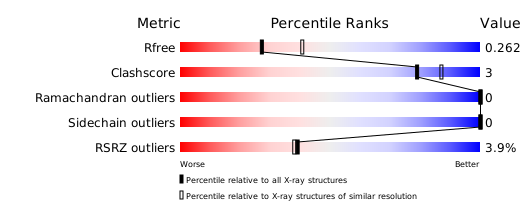
Structure validation
Download full validation report


