






 1UPT
1UPT
Structure of a complex of the golgin-245 GRIP domain with Arl1
Summary for 1UPT
| Entry DOI | 10.2210/pdb1upt/pdb |
| Descriptor | ADP-RIBOSYLATION FACTOR-LIKE PROTEIN 1, GOLGI AUTOANTIGEN, GOLGIN SUBFAMILY A MEMBER 4, GUANOSINE-5'-TRIPHOSPHATE, ... (5 entities in total) |
| Functional Keywords | hydrolase/protein-binding, complex (gtpase-golgin), golgin-245, grip, arl1, golgin, gtpase, g-protein, golgi, grip dimer, protein sorting, vesicle trafficking, hydrolase-protein-binding complex |
| Biological source | HOMO SAPIENS (HUMAN) More |
| Total number of polymer chains | 8 |
| Total formula weight | 110619.49 |
| Authors | Panic, B.,Perisic, O.,Veprintsev, D.B.,Williams, R.L.,Munro, S. (deposition date: 2003-10-12, release date: 2003-10-30, Last modification date: 2024-10-23) |
| Primary citation | Panic, B.,Perisic, O.,Veprintsev, D.B.,Williams, R.L.,Munro, S. Structural Basis for Arl1-Dependent Targeting of Homodimeric Grip Domains to the Golgi Apparatus Mol.Cell, 12:863-, 2003 Cited by PubMed Abstract: Golgins are large coiled-coil proteins that play a role in Golgi structure and vesicle traffic. The Arf-like GTPase Arl1 regulates the translocation of GRIP domain-containing golgins to Golgi membranes. We report here the 1.7 A resolution structure of human Arl1-GTP in a complex with the GRIP domain of golgin-245. The structure reveals that the GRIP domain consists of an S-shaped arrangement of three helices. The domain forms a homodimer that binds two Arl1-GTPs using two helices from each monomer. The structure is consistent with golgin-245 forming parallel coiled-coils and suggests how Arl1-GTP/GRIP complexes interact with Golgi membranes via the N termini of Arl1-GTP and the C-terminal tails of the GRIP domains. In cells, bivalent association with Arl1-GTP would increase residence time of the golgins on Golgi membranes. Despite no conservation of sequence, topology, or even helical direction, several other effectors form similar interactions with small GTPases via a pair of alpha helices, suggesting a common structural basis for effector recognition. PubMed: 14580338DOI: 10.1016/S1097-2765(03)00356-3 PDB entries with the same primary citation |
| Experimental method | X-RAY DIFFRACTION (1.7 Å) |
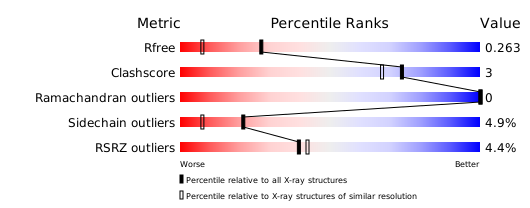
Structure validation
Download full validation report


