






 10DC
10DC
H-Ras GTPase R68A bound to GppNHp
Summary for 10DC
| Entry DOI | 10.2210/pdb10dc/pdb |
| Related | 4N9A 4N9B 4N9C |
| Descriptor | GTPase HRas, PHOSPHOAMINOPHOSPHONIC ACID-GUANYLATE ESTER, MAGNESIUM ION, ... (4 entities in total) |
| Functional Keywords | small gtpase, ras gtpase, gtp analog, hydrolase, signaling protein |
| Biological source | Homo sapiens (human) |
| Total number of polymer chains | 1 |
| Total formula weight | 19335.58 |
| Authors | Knihtila, R.,Marcus, K.,Mattos, C. (deposition date: 2026-01-13, release date: 2026-02-11, Last modification date: 2026-03-18) |
| Primary citation | Marcus, K.,Schwabe, M.,Knihtila, R.,Mattos, C. An evolutionarily conserved salt bridge stabilizes the active site for GTP hydrolysis in Rho GTPases. J.Biol.Chem., 302:111260-111260, 2026 Cited by PubMed Abstract: Rho GTPases are members of the Ras superfamily of small GTPases that regulate cell morphology, motility, polarization and cell cycling. Like members of the Ras subfamily, Rho subfamily GTPases dysregulation is implicated in a range of tumors and can serve as a valid drug target. In this work, we investigate the evolutionary trajectory of Rho GTPases within a region of the protein that has been exploited for cancer drug discovery within the Ras subfamily branch - the "switch II pocket". Our previous work has illustrated the role of allostery in this region of H-Ras in modulation of intrinsic hydrolysis and effector-binding capacity. Here, we report that a highly conserved salt bridge within the Rho subfamily stabilizes the RhoA GTPase active site in a catalytically favorable conformation. We probed the roles of the Rho salt bridge via X-ray crystallography, accelerated molecular dynamics simulations (aMD), and enzymatic studies. We showed that the removal of a residue within switch II of RhoA, the salt bridge residue R70, can impart catastrophic effects on active site organization and GTP hydrolysis. As expected, removal of the analogous R68 in H-Ras, which is not involved in a salt bridge interaction, results in a structure with changes in the active site and a decrease in GTP hydrolysis rate constant that are more moderate than observed for RhoA. The anionic partner of R70, E102, also modulates active site conformation and, upon removal, decreases intrinsic hydrolysis. Based on aMD simulations, we uncovered evidence of epistatic relationships between the Rho salt bridge, the distal residue K98 and P-loop residue D13 which coordinate allosteric communication from the switch regions directly to the active site. Finally, we describe the functional landscape of switch II pocket in the context of both Rho subfamily evolution and potential for drug discovery. PubMed: 41654137DOI: 10.1016/j.jbc.2026.111260 PDB entries with the same primary citation |
| Experimental method | X-RAY DIFFRACTION (2.08 Å) |
Structure validation
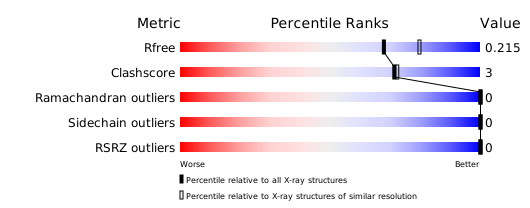
Download full validation report


