 Movie
Movie Controller


+ Open data

- Basic information
| Entry | Database: PDB / ID: 9umj | ||||||||||||
|---|---|---|---|---|---|---|---|---|---|---|---|---|---|
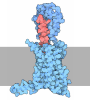
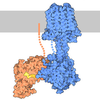
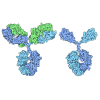
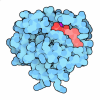
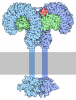
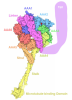
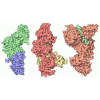
| Title | Structure of EP54 bound mouse C3aR in complex with Go | ||||||||||||
 Components Components |
| ||||||||||||
 Keywords Keywords | SIGNALING PROTEIN / GPCR / G protein / SIGNALING PROTEIN-IMMUNE SYSTEM complex | ||||||||||||
| Function / homology |  Function and homology information Function and homology informationtolerance induction to nonself antigen / complement component C3a binding / complement component C3a receptor activity / Regulation of Complement cascade / Peptide ligand-binding receptors / complement component C5a receptor activity / Muscarinic acetylcholine receptors / G protein-coupled acetylcholine receptor activity / G alpha (i) signalling events / positive regulation of glomerular mesangial cell proliferation ...tolerance induction to nonself antigen / complement component C3a binding / complement component C3a receptor activity / Regulation of Complement cascade / Peptide ligand-binding receptors / complement component C5a receptor activity / Muscarinic acetylcholine receptors / G protein-coupled acetylcholine receptor activity / G alpha (i) signalling events / positive regulation of glomerular mesangial cell proliferation / regulation of locomotion / mu-type opioid receptor binding / adenylate cyclase-inhibiting G protein-coupled acetylcholine receptor signaling pathway / corticotropin-releasing hormone receptor 1 binding / complement receptor mediated signaling pathway / negative regulation of neurotransmitter secretion / G protein-coupled dopamine receptor signaling pathway / positive regulation of neutrophil chemotaxis / positive regulation of DNA biosynthetic process / positive regulation of macrophage chemotaxis / parallel fiber to Purkinje cell synapse / negative regulation of insulin secretion / positive regulation of vascular endothelial growth factor production / G protein-coupled receptor signaling pathway, coupled to cyclic nucleotide second messenger / postsynaptic modulation of chemical synaptic transmission / Neutrophil degranulation / positive regulation of smooth muscle cell proliferation / muscle contraction / adenylate cyclase-inhibiting dopamine receptor signaling pathway / adenylate cyclase-inhibiting serotonin receptor signaling pathway / G protein-coupled serotonin receptor binding / calcium-mediated signaling / regulation of blood pressure / GABA-ergic synapse / chemotaxis / G protein-coupled receptor activity / positive regulation of angiogenesis / G-protein beta/gamma-subunit complex binding / adenylate cyclase-inhibiting G protein-coupled receptor signaling pathway / adenylate cyclase-modulating G protein-coupled receptor signaling pathway / Olfactory Signaling Pathway / Activation of the phototransduction cascade / phospholipase C-activating G protein-coupled receptor signaling pathway / G protein-coupled acetylcholine receptor signaling pathway / G beta:gamma signalling through PLC beta / Presynaptic function of Kainate receptors / Thromboxane signalling through TP receptor / Activation of G protein gated Potassium channels / Inhibition of voltage gated Ca2+ channels via Gbeta/gamma subunits / G-protein activation / Glucagon signaling in metabolic regulation / G beta:gamma signalling through CDC42 / Prostacyclin signalling through prostacyclin receptor / Synthesis, secretion, and inactivation of Glucagon-like Peptide-1 (GLP-1) / photoreceptor disc membrane / G beta:gamma signalling through BTK / ADP signalling through P2Y purinoceptor 12 / Sensory perception of sweet, bitter, and umami (glutamate) taste / Glucagon-type ligand receptors / Adrenaline,noradrenaline inhibits insulin secretion / Vasopressin regulates renal water homeostasis via Aquaporins / G alpha (z) signalling events / Glucagon-like Peptide-1 (GLP1) regulates insulin secretion / ADP signalling through P2Y purinoceptor 1 / cellular response to catecholamine stimulus / G beta:gamma signalling through PI3Kgamma / ADORA2B mediated anti-inflammatory cytokines production / adenylate cyclase-activating dopamine receptor signaling pathway / heterotrimeric G-protein complex / cellular response to prostaglandin E stimulus / Cooperation of PDCL (PhLP1) and TRiC/CCT in G-protein beta folding / GPER1 signaling / G alpha (12/13) signalling events / Inactivation, recovery and regulation of the phototransduction cascade / G-protein beta-subunit binding / extracellular vesicle / positive regulation of cytosolic calcium ion concentration / Thrombin signalling through proteinase activated receptors (PARs) / signaling receptor complex adaptor activity / chemical synaptic transmission / GTPase binding / cell body / G protein activity / presynaptic membrane / Ca2+ pathway / High laminar flow shear stress activates signaling by PIEZO1 and PECAM1:CDH5:KDR in endothelial cells / G alpha (i) signalling events / G alpha (s) signalling events / G alpha (q) signalling events / Hydrolases; Acting on acid anhydrides; Acting on GTP to facilitate cellular and subcellular movement / cytoplasmic side of plasma membrane / Ras protein signal transduction / inflammatory response / cell surface receptor signaling pathway / Extra-nuclear estrogen signaling / postsynaptic membrane / positive regulation of cell migration / G protein-coupled receptor signaling pathway / lysosomal membrane / GTPase activity Similarity search - Function | ||||||||||||
| Biological species |  Homo sapiens (human) Homo sapiens (human)  Mus musculus (house mouse) Mus musculus (house mouse) | ||||||||||||
| Method | ELECTRON MICROSCOPY / single particle reconstruction / cryo EM / Resolution: 3.38 Å | ||||||||||||
 Authors Authors | Banerjee, R. / Yadav, M.K. / Yadav, R. / Ganguly, M. / Mishra, S. / Dalal, A. / Gati, C. / Shukla, A.K. | ||||||||||||
| Funding support |  India, India,  United Kingdom, 3items United Kingdom, 3items
| ||||||||||||
 Citation Citation | Journal: bioRxiv / Year: 2025 Title: Molecular fingerprints of a convergent mechanism orchestrating diverse ligand recognition and species-specific pharmacology at the complement anaphylatoxin receptors. Authors: Sudha Mishra / Manish K Yadav / Annu Dalal / Manisankar Ganguly / Ravi Yadav / Kazuhiro Sawada / Divyanshu Tiwari / Nabarun Roy / Nilanjana Banerjee / Jenny N Fung / Jianina Marallag / ...Authors: Sudha Mishra / Manish K Yadav / Annu Dalal / Manisankar Ganguly / Ravi Yadav / Kazuhiro Sawada / Divyanshu Tiwari / Nabarun Roy / Nilanjana Banerjee / Jenny N Fung / Jianina Marallag / Cedric S Cui / Xaria X Li / John D Lee / Calvin Aaron Dsouza / Shirsha Saha / Parishmita Sarma / Ganita Rawat / Houming Zhu / Htet A Khant / Richard J Clark / Fumiya K Sano / Ramanuj Banerjee / Trent M Woodruff / Osamu Nureki / Cornelius Gati / Arun K Shukla /    Abstract: Complement anaphylatoxin receptors (C3aR and C5aR1) are prototypical G protein-coupled receptors (GPCRs) playing crucial physiological roles in innate immunity by combating pathogenic infections and ...Complement anaphylatoxin receptors (C3aR and C5aR1) are prototypical G protein-coupled receptors (GPCRs) playing crucial physiological roles in innate immunity by combating pathogenic infections and orchestrating inflammatory responses. They continue to be important therapeutic targets for multiple disorders including autoimmune diseases, acute and chronic inflammation, and allergy-related conditions. Recent structural coverage has provided important insights into their activation and signaling, however, confounding observations in the literature related to ligand efficacy and functional responses, especially in different model systems, present a major challenge for drug discovery efforts. Here, we systematically and comprehensively profile a broad set of natural and synthetic ligands at C3aR and C5aR1 and discover a previously unanticipated level of functional specialization in terms of species-specific pharmacology and receptor activation. Taking a lead from this, we determine seventeen cryo-EM structures of different ligand-receptor-G-protein complexes and uncover distinct orientation of agonists between the human and mouse receptors despite an overlapping positioning in the orthosteric binding pocket. Combined with extensive mutagenesis and functional assays, these structural snapshots allow us to decode and validate a convergent molecular mechanism involving a "Five-Point-Switch" in these receptors that orchestrates the recognition and efficacy of diverse agonists. We also identify species-specific differences at the level of phosphorylation patterns encoded in the carboxyl-terminus of these receptors and directly visualize their impact on βarr binding and activation using cryo-EM structures. Interestingly, we observe that βarrs engage with the mouse C5aR1 using a variation of previously discovered P-X-P-P phosphorylation motif via a "Sliding-Mechanism" and also exhibit distinct oligomeric state for the human vs. mouse receptors. Taken together, this study elucidates functional specialization at the complement anaphylatoxin receptors and underlying molecular mechanisms, offering a previously lacking framework with direct and immediate implications for the development of novel therapeutics. | ||||||||||||
| History |
|
- Structure visualization
| Structure viewer | Molecule: MolmilJmol/JSmol |
|---|
- Downloads & links
-Download
| PDBx/mmCIF format | 9umj.cif.gz | 212 KB | Display | PDBx/mmCIF format |
|---|---|---|---|---|
| PDB format | pdb9umj.ent.gz | 158.7 KB | Display | PDB format |
| PDBx/mmJSON format | 9umj.json.gz | Tree view | PDBx/mmJSON format | |
| Others |  Other downloads Other downloads |
-Validation report
| Arichive directory | https://data.pdbj.org/pub/pdb/validation_reports/um/9umjftp://data.pdbj.org/pub/pdb/validation_reports/um/9umj | HTTPS FTP |
|---|
-Related structure data
| Related structure data |  64276MC  9kutC  9kv6C  9kv8C  9kvpC  9kwgC  9kwxC  9kx6C  9ky2C  9kyuC  9kzkC  9l0hC  9umrC  9umxC M: map data used to model this data C: citing same article ( |
|---|---|
| Similar structure data |


-Links
 PDBj
PDBj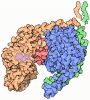
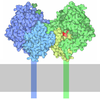

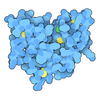
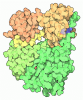
- Assembly
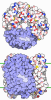
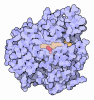
| Deposited unit | 
|
|---|---|
| 1 |
|
-Components
-Guanine nucleotide-binding protein ... , 3 types, 3 molecules ABG
| #3: Protein | Mass: 27024.762 Da / Num. of mol.: 1 / Mutation: G42D,E43N,A227D,G230D,I332A,V335I Source method: isolated from a genetically manipulated source Source: (gene. exp.) Homo sapiens (human) / Gene: GNAO1 / Production host:   Escherichia coli (E. coli) Escherichia coli (E. coli)References: UniProt: P09471, Hydrolases; Acting on acid anhydrides; Acting on GTP to facilitate cellular and subcellular movement |
|---|---|
| #4: Protein | Mass: 38534.062 Da / Num. of mol.: 1 Source method: isolated from a genetically manipulated source Source: (gene. exp.) Homo sapiens (human) / Gene: GNB1 / Production host:   Spodoptera frugiperda (fall armyworm) / References: UniProt: P62873 Spodoptera frugiperda (fall armyworm) / References: UniProt: P62873 |
| #5: Protein | Mass: 7861.143 Da / Num. of mol.: 1 Source method: isolated from a genetically manipulated source Source: (gene. exp.) Homo sapiens (human) / Gene: GNG2 / Production host: Spodoptera frugiperda (fall armyworm) / References: UniProt: P59768 |
-Protein/peptide / Protein / Antibody , 3 types, 3 molecules DCH
| #1: Protein/peptide | Mass: 1211.475 Da / Num. of mol.: 1 / Source method: obtained synthetically / Source: (synth.) Homo sapiens (human) |
|---|---|
| #2: Protein | Mass: 59526.031 Da / Num. of mol.: 1 Source method: isolated from a genetically manipulated source Source: (gene. exp.) Homo sapiens (human), (gene. exp.) Mus musculus (house mouse)Gene: CHRM4, C3ar1, C3r1 / Production host: Spodoptera frugiperda (fall armyworm) / References: UniProt: P08173, UniProt: O09047 |
| #6: Antibody | Mass: 26466.486 Da / Num. of mol.: 1 Source method: isolated from a genetically manipulated source Source: (gene. exp.) Mus musculus (house mouse) / Production host: Escherichia coli (E. coli) |
-Details
| Has ligand of interest | Y |
|---|---|
| Has protein modification | Y |
-Experimental details
-Experiment
| Experiment | Method: ELECTRON MICROSCOPY |
|---|---|
| EM experiment | Aggregation state: PARTICLE / 3D reconstruction method: single particle reconstruction |
- Sample preparation
| Component |
| ||||||||||||||||||||||||||||||||||||||||||||||||||||||||
|---|---|---|---|---|---|---|---|---|---|---|---|---|---|---|---|---|---|---|---|---|---|---|---|---|---|---|---|---|---|---|---|---|---|---|---|---|---|---|---|---|---|---|---|---|---|---|---|---|---|---|---|---|---|---|---|---|---|
| Source (natural) |
| ||||||||||||||||||||||||||||||||||||||||||||||||||||||||
| Source (recombinant) |
| ||||||||||||||||||||||||||||||||||||||||||||||||||||||||
| Buffer solution | pH: 7.4 | ||||||||||||||||||||||||||||||||||||||||||||||||||||||||
| Specimen | Embedding applied: NO / Shadowing applied: NO / Staining applied: NO / Vitrification applied: YES | ||||||||||||||||||||||||||||||||||||||||||||||||||||||||
| Vitrification | Cryogen name: ETHANE |
- Electron microscopy imaging
| Microscopy | Model: TFS GLACIOS |
|---|---|
| Electron gun | Electron source:  FIELD EMISSION GUN / Accelerating voltage: 200 kV / Illumination mode: FLOOD BEAM FIELD EMISSION GUN / Accelerating voltage: 200 kV / Illumination mode: FLOOD BEAM |
| Electron lens | Mode: BRIGHT FIELD / Nominal defocus max: 3200 nm / Nominal defocus min: 800 nm |
| Image recording | Electron dose: 50 e/Å2 / Detector mode: COUNTING / Film or detector model: FEI FALCON IV (4k x 4k) |
| Image scans | Movie frames/image: 40 |
- Processing
| EM software |
| ||||||||||||||||||||||||||||||||||||||||
|---|---|---|---|---|---|---|---|---|---|---|---|---|---|---|---|---|---|---|---|---|---|---|---|---|---|---|---|---|---|---|---|---|---|---|---|---|---|---|---|---|---|
| CTF correction | Type: NONE | ||||||||||||||||||||||||||||||||||||||||
| Symmetry | Point symmetry: C1 (asymmetric) | ||||||||||||||||||||||||||||||||||||||||
| 3D reconstruction | Resolution: 3.38 Å / Resolution method: FSC 0.143 CUT-OFF / Num. of particles: 199691 / Symmetry type: POINT | ||||||||||||||||||||||||||||||||||||||||
| Atomic model building | Protocol: FLEXIBLE FIT / Space: REAL | ||||||||||||||||||||||||||||||||||||||||
| Refine LS restraints |
|
