 Movie
Movie Controller


+ Open data

- Basic information
| Entry | Database: PDB / ID: 9cqc | |||||||||||||||||||||||||||||||||
|---|---|---|---|---|---|---|---|---|---|---|---|---|---|---|---|---|---|---|---|---|---|---|---|---|---|---|---|---|---|---|---|---|---|---|
| Title | The ligation complex like in the NHEJ pathway | |||||||||||||||||||||||||||||||||
 Components Components |
| |||||||||||||||||||||||||||||||||
 Keywords Keywords | LIGASE/TRANSFERASE/DNA / NHEJ / ligation / XLF / PAXX / DNA repair / Ligase IV / LIGASE-TRANSFERASE-DNA complex | |||||||||||||||||||||||||||||||||
| Function / homology |  Function and homology information Function and homology informationT cell receptor V(D)J recombination / FHA domain binding / positive regulation of chromosome organization / pro-B cell differentiation / DNA ligase IV complex / positive regulation of ligase activity / DNA ligase activity / DNA double-strand break attachment to nuclear envelope / DNA ligase (ATP) / Ku70:Ku80 complex ...T cell receptor V(D)J recombination / FHA domain binding / positive regulation of chromosome organization / pro-B cell differentiation / DNA ligase IV complex / positive regulation of ligase activity / DNA ligase activity / DNA double-strand break attachment to nuclear envelope / DNA ligase (ATP) / Ku70:Ku80 complex / negative regulation of t-circle formation / DNA ligase (ATP) activity / DNA end binding / small-subunit processome assembly / positive regulation of lymphocyte differentiation / DNA-dependent protein kinase complex / DNA-dependent protein kinase-DNA ligase 4 complex / immunoglobulin V(D)J recombination / nucleotide-excision repair, DNA gap filling / isotype switching / nonhomologous end joining complex / V(D)J recombination / cellular response to X-ray / regulation of smooth muscle cell proliferation / somatic stem cell population maintenance / double-strand break repair via classical nonhomologous end joining / protein localization to site of double-strand break / Cytosolic sensors of pathogen-associated DNA / nuclear telomere cap complex / single strand break repair / IRF3-mediated induction of type I IFN / positive regulation of neurogenesis / cellular hyperosmotic salinity response / U3 snoRNA binding / regulation of telomere maintenance / recombinational repair / ligase activity / response to X-ray / chromosome organization / protein localization to chromosome, telomeric region / DNA biosynthetic process / 2-LTR circle formation / response to ionizing radiation / telomeric repeat DNA binding / T cell differentiation / DNA 3'-5' helicase / 5'-deoxyribose-5-phosphate lyase activity / T cell differentiation in thymus / neuron apoptotic process / ATP-dependent activity, acting on DNA / 3'-5' DNA helicase activity / telomere maintenance via telomerase / SUMOylation of DNA damage response and repair proteins / B cell differentiation / condensed chromosome / DNA polymerase binding / response to gamma radiation / in utero embryonic development / activation of innate immune response / positive regulation of fibroblast proliferation / telomere maintenance / cyclin binding / DNA-(apurinic or apyrimidinic site) lyase / class I DNA-(apurinic or apyrimidinic site) endonuclease activity / cellular response to ionizing radiation / DNA helicase activity / central nervous system development / site of DNA damage / small-subunit processome / Nonhomologous End-Joining (NHEJ) / cellular response to gamma radiation / protein-DNA complex / establishment of integrated proviral latency / double-strand break repair via nonhomologous end joining / base-excision repair / fibrillar center / cell population proliferation / enzyme activator activity / double-strand break repair / site of double-strand break / negative regulation of neuron apoptotic process / transcription regulator complex / DNA recombination / double-stranded DNA binding / scaffold protein binding / secretory granule lumen / ficolin-1-rich granule lumen / damaged DNA binding / molecular adaptor activity / innate immune response / chromosome, telomeric region / protein-macromolecule adaptor activity / transcription cis-regulatory region binding / chromosome / ribonucleoprotein complex / negative regulation of DNA-templated transcription / ubiquitin protein ligase binding / DNA damage response / nucleolus / Neutrophil degranulation Similarity search - Function | |||||||||||||||||||||||||||||||||
| Biological species |  Homo sapiens (human) Homo sapiens (human) | |||||||||||||||||||||||||||||||||
| Method | ELECTRON MICROSCOPY / single particle reconstruction / cryo EM / Resolution: 3.4 Å | |||||||||||||||||||||||||||||||||
 Authors Authors | Li, J. / Liu, L. / Gellert, M. / Yang, W. | |||||||||||||||||||||||||||||||||
| Funding support |  United States, 1items United States, 1items
| |||||||||||||||||||||||||||||||||
 Citation Citation | Journal: Nature / Year: 2025 Title: Dynamic assemblies and coordinated reactions of non-homologous end joining. Authors: Lan Liu / Jun Li / Metztli Cisneros-Aguirre / Arianna Merkell / Jeremy M Stark / Martin Gellert / Wei Yang / Abstract: Non-homologous end joining (NHEJ) is the main repair pathway of double-strand DNA breaks in higher eukaryotes. Here we report reconstitution of the final steps of NHEJ and structures of DNA ...Non-homologous end joining (NHEJ) is the main repair pathway of double-strand DNA breaks in higher eukaryotes. Here we report reconstitution of the final steps of NHEJ and structures of DNA polymerase μ and ligase IV (LIG4) engaged in gap filling and end joining. These reactions take place in a flexible ω-shaped framework composed of XRCC4 and XLF. Two broken DNA ends, each encircled by Ku70-Ku80 internally, are docked onto the ω frame, mediated by LIG4. DNA polymerase and ligase attached to each ω arm repair only one broken strand of a defined polarity; the final steps of NHEJ requires coordination and toggling of a pair of such enzymes. The facilitators XLF and PAXX additively stimulate NHEJ reactions. As DNA-end sensor and protector, LIG4 replaces DNA-PKcs for end joining and bridges the two DNA ends for polymerase to fill remaining gaps. These assemblies present new targets for NHEJ inhibition to enhance efficacy of radiotherapy and accuracy of gene editing. | |||||||||||||||||||||||||||||||||
| History |
|
- Structure visualization
| Structure viewer | Molecule: MolmilJmol/JSmol |
|---|
- Downloads & links
-Download
| PDBx/mmCIF format | 9cqc.cif.gz | 921.3 KB | Display | PDBx/mmCIF format |
|---|---|---|---|---|
| PDB format | pdb9cqc.ent.gz | 713.2 KB | Display | PDB format |
| PDBx/mmJSON format | 9cqc.json.gz | Tree view | PDBx/mmJSON format | |
| Others |  Other downloads Other downloads |
-Validation report
| Arichive directory | https://data.pdbj.org/pub/pdb/validation_reports/cq/9cqcftp://data.pdbj.org/pub/pdb/validation_reports/cq/9cqc | HTTPS FTP |
|---|
-Related structure data
| Related structure data |  45813MC  9cq3C  9cq6C  9n81C  9n82C  9n83C M: map data used to model this data C: citing same article ( |
|---|---|
| Similar structure data |


-Links
 PDBj
PDBj
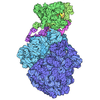
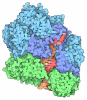
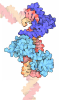
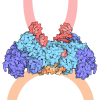
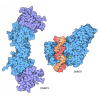
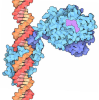
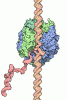

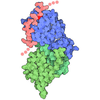
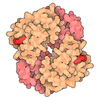
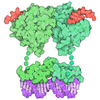
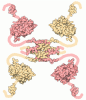
- Assembly
| Deposited unit | 
|
|---|---|
| 1 |
|
-Components
-X-ray repair cross-complementing protein ... , 2 types, 4 molecules AaBb
| #1: Protein | Mass: 70198.336 Da / Num. of mol.: 2 Source method: isolated from a genetically manipulated source Source: (gene. exp.) Homo sapiens (human) / Gene: XRCC6, G22P1 / Cell line (production host): HEK293T / Production host: Homo sapiens (human)References: UniProt: P12956, Hydrolases; Acting on acid anhydrides; Acting on acid anhydrides to facilitate cellular and subcellular movement, Lyases; Carbon-oxygen lyases; Other carbon-oxygen lyases #2: Protein | Mass: 82812.438 Da / Num. of mol.: 2 Source method: isolated from a genetically manipulated source Source: (gene. exp.) Homo sapiens (human) / Cell line (production host): HEK293T / Production host: Homo sapiens (human) / References: UniProt: P13010 |
|---|
-Protein , 4 types, 10 molecules CcDEdeFfGH
| #3: Protein | Mass: 33625.535 Da / Num. of mol.: 2 Source method: isolated from a genetically manipulated source Source: (gene. exp.) Homo sapiens (human) / Gene: NHEJ1, XLF / Production host: Homo sapiens (human) / References: UniProt: Q9H9Q4#4: Protein | Mass: 38337.703 Da / Num. of mol.: 4 Source method: isolated from a genetically manipulated source Source: (gene. exp.) Homo sapiens (human) / Gene: XRCC4 / Cell line (production host): HEK293T / Production host: Homo sapiens (human) / References: UniProt: Q13426#5: Protein | Mass: 104378.250 Da / Num. of mol.: 2 Source method: isolated from a genetically manipulated source Source: (gene. exp.) Homo sapiens (human) / Gene: LIG4 / Cell line (production host): HEK293T / Production host: Homo sapiens (human) / References: UniProt: P49917, DNA ligase (ATP)#6: Protein | Mass: 23282.197 Da / Num. of mol.: 2 Source method: isolated from a genetically manipulated source Source: (gene. exp.) Homo sapiens (human) / Gene: PAXX, C9orf142, XLS / Production host:   Escherichia coli (E. coli) / References: UniProt: Q9BUH6 Escherichia coli (E. coli) / References: UniProt: Q9BUH6 |
|---|
-DNA chain , 4 types, 4 molecules IJKL
| #7: DNA chain | Mass: 20737.299 Da / Num. of mol.: 1 / Source method: obtained synthetically / Source: (synth.) Homo sapiens (human) |
|---|---|
| #8: DNA chain | Mass: 20795.354 Da / Num. of mol.: 1 / Source method: obtained synthetically / Source: (synth.) Homo sapiens (human) |
| #9: DNA chain | Mass: 15865.188 Da / Num. of mol.: 1 / Source method: obtained synthetically / Source: (synth.) Homo sapiens (human) |
| #10: DNA chain | Mass: 15493.929 Da / Num. of mol.: 1 / Source method: obtained synthetically / Source: (synth.) Homo sapiens (human) |
-Non-polymers , 1 types, 1 molecules 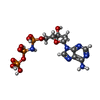
| #11: Chemical | ChemComp-DZ4 / 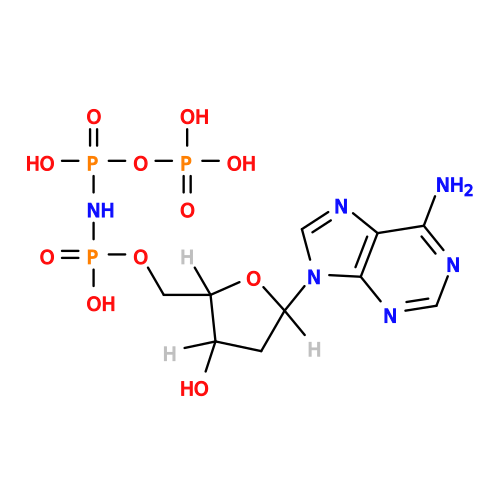 Mass: 490.197 Da / Num. of mol.: 1 / Source method: obtained synthetically / Formula: C10H17N6O11P3 / Feature type: SUBJECT OF INVESTIGATION Mass: 490.197 Da / Num. of mol.: 1 / Source method: obtained synthetically / Formula: C10H17N6O11P3 / Feature type: SUBJECT OF INVESTIGATION |
|---|
-Details
| Has ligand of interest | Y |
|---|---|
| Has protein modification | N |
-Experimental details
-Experiment
| Experiment | Method: ELECTRON MICROSCOPY |
|---|---|
| EM experiment | Aggregation state: PARTICLE / 3D reconstruction method: single particle reconstruction |
- Sample preparation
| Component | Name: Ligation complex like in the NHEJ pathway / Type: COMPLEX / Entity ID: #1-#10 / Source: MULTIPLE SOURCES |
|---|---|
| Molecular weight | Value: 0.854 MDa / Experimental value: NO |
| Source (natural) | Organism: Homo sapiens (human) |
| Source (recombinant) | Organism: Homo sapiens (human) |
| Buffer solution | pH: 7.9 |
| Specimen | Conc.: 0.35 mg/ml / Embedding applied: NO / Shadowing applied: NO / Staining applied: NO / Vitrification applied: YES |
| Vitrification | Cryogen name: ETHANE / Humidity: 100 % / Chamber temperature: 277 K |
- Electron microscopy imaging
| Experimental equipment |  Model: Titan Krios / Image courtesy: FEI Company |
|---|---|
| Microscopy | Model: FEI TITAN KRIOS |
| Electron gun | Electron source:  FIELD EMISSION GUN / Accelerating voltage: 300 kV / Illumination mode: FLOOD BEAM FIELD EMISSION GUN / Accelerating voltage: 300 kV / Illumination mode: FLOOD BEAM |
| Electron lens | Mode: BRIGHT FIELD / Nominal defocus max: 1500 nm / Nominal defocus min: 500 nm |
| Image recording | Electron dose: 54.4 e/Å2 / Film or detector model: GATAN K3 BIOQUANTUM (6k x 4k) |
- Processing
| EM software | Name: SerialEM / Category: image acquisition |
|---|---|
| CTF correction | Type: PHASE FLIPPING AND AMPLITUDE CORRECTION |
| Symmetry | Point symmetry: C1 (asymmetric) |
| 3D reconstruction | Resolution: 3.4 Å / Resolution method: FSC 0.143 CUT-OFF / Num. of particles: 133163 Details: The resolution is calculated by postprocess in RELION based on the composite half maps generated by phenix.combine_focused_maps. Symmetry type: POINT |
| Refinement | Cross valid method: NONE |
