






 9YRK
9YRK
Cryo-EM structure of SARS-CoV-2 nsp10-nsp14 (E191A) in complex with T20P14-B complex, dimeric form
Summary for 9YRK
| Entry DOI | 10.2210/pdb9yrk/pdb |
| EMDB information | 73369 |
| Descriptor | Non-structural protein 10, Proofreading exoribonuclease, T20P14-B RNA, ... (7 entities in total) |
| Functional Keywords | sars-cov-2, replication and transcription, mismatch, proofreading exoribonuclease, viral protein, viral protein-rna complex, nucleoside analog, viral protein/rna |
| Biological source | Severe acute respiratory syndrome coronavirus 2 More |
| Total number of polymer chains | 6 |
| Total formula weight | 164322.03 |
| Authors | |
| Primary citation | Liu, C.,Li, Y.,Cao, X.,Gleason, R.J.,Liu, B.,Yang, Y. Mechanism of SARS-CoV-2 resistance to nucleotide analog-based antivirals. Nat Commun, 17:1601-1601, 2026 Cited by PubMed Abstract: The remarkable ability of SARS-CoV-2 to resist many nucleotide analog (NA)-based antivirals represents a formidable challenge to therapeutic efforts. Here, we reveal fundamental insights into how its unique proofreading exoribonuclease (ExoN) counteracts two representative NA antivirals, bemnifosbuvir and sofosbuvir, which are designed to inhibit the viral RNA polymerase (RdRp). Our findings unveil that NA incorporation alters RNA-binding dynamics, significantly increasing the affinity of RNA to ExoN while weakening its interaction with RdRp. This shift likely facilitates RNA dissociation from RdRp, subsequent recognition by ExoN, and excision of NAs. Strikingly, we elucidate the mechanism underlying varied levels of resilience of different NAs to ExoN excision. Our cryo-EM structures of ExoN in complex with either of the two NA-incorporated RNAs reveal previously unknown ExoN-NA interactions mediated by the functional groups on the modified ribose rings of NAs, illuminating the key determinants of their recognition and excision. Furthermore, we identify an allosteric regulatory loop of ExoN that promotes the full activation of ExoN but is displaced by the binding of NAs exhibiting resilience to ExoN excision. These discoveries provide a molecular framework for understanding SARS-CoV-2 resistance to NA-based antivirals and highlight mechanisms that could be exploited to improve anti-coronavirus drug design. PubMed: 41530153DOI: 10.1038/s41467-026-68304-8 PDB entries with the same primary citation |
| Experimental method | ELECTRON MICROSCOPY (3.1 Å) |
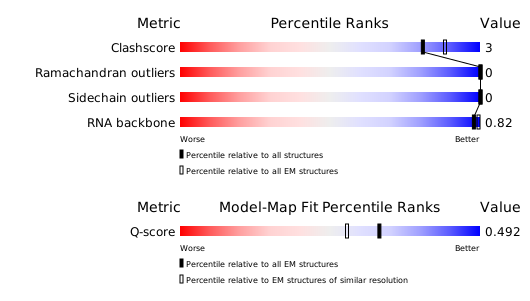
Structure validation
Download full validation report


