






 9YE9
9YE9
Structure of UbcH5b in complex with the U-box domain of the E3 ubiquitin ligase CHIP
Summary for 9YE9
| Entry DOI | 10.2210/pdb9ye9/pdb |
| Descriptor | Ubiquitin-conjugating enzyme E2 D2, E3 ubiquitin-protein ligase CHIP, BETA-MERCAPTOETHANOL, ... (5 entities in total) |
| Functional Keywords | ubiquitin conjugating enzyme, ubiquitin ligase, ligase |
| Biological source | Homo sapiens (human) More |
| Total number of polymer chains | 3 |
| Total formula weight | 37432.75 |
| Authors | Manage, M.M.,Nix, J.C.,Page, R.C. (deposition date: 2025-09-23, release date: 2025-11-05, Last modification date: 2025-11-12) |
| Primary citation | Manage, M.M.,Nix, J.C.,Page, R.C. Functional and structural analyses of UbcH5 mutants with enhanced binding to the E3 ubiquitin ligase CHIP. Biochem.Biophys.Res.Commun., 789:152873-152873, 2025 Cited by PubMed Abstract: The E3 ubiquitin ligase CHIP ubiquitinates substrates in chaperone-dependent or -independent manners. Structural studies, particularly by cryo-electron microscopy, would aid in understanding the mechanisms governing CHIP-mediated ubiquitination. Key among necessary components is the E2 enzyme UbcH5b, which facilitates the transfer of ubiquitin from the E2∼ubiquitin conjugate to a target lysine residue. However, the affinity of CHIP for UbcH5b is approximately 4 μM, presenting a challenge for cryo-electron microscopy, which is typically conducted at concentrations below 5 μM. Herein, we report structure-guided UbcH5b mutants that substantially improve the affinity for CHIP. Bio-layer interferometry demonstrates a ten-fold improvement in affinity, while our crystal structure of mutant UbcH5b in complex with CHIP indicates conservation of the canonical E2/E3 interaction. E2∼ubiquitin conjugate formation assays and a mutant, isopeptide-linked E2∼ubiquitin conjugate structure demonstrate compatibility of the mutants with the E1 enzyme. Assays of CHIP auto-ubiquitination and CHIP-mediated ubiquitination of Hsp70 demonstrate full compatibility of the mutants with all components of the ubiquitination cascade. Thus, our structure-guided UbcH5b mutants retain native activity profiles and structures while improving the affinity for CHIP, thereby enabling future structural studies. PubMed: 41167006DOI: 10.1016/j.bbrc.2025.152873 PDB entries with the same primary citation |
| Experimental method | X-RAY DIFFRACTION (2.01 Å) |
Structure validation
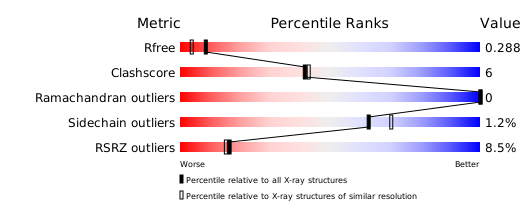
Download full validation report


