






 9YA3
9YA3
Cryo-EM structure of the apical region of subpellicular microtubule (SPMT) from Toxoplasma gondii (8-nm repeat)
This is a non-PDB format compatible entry.
Summary for 9YA3
| Entry DOI | 10.2210/pdb9ya3/pdb |
| EMDB information | 72719 |
| Descriptor | Microtubule associated protein SPM1, GUANOSINE-5'-TRIPHOSPHATE, MAGNESIUM ION, ... (11 entities in total) |
| Functional Keywords | tubulin, microtubule, microtubule inner protein, microtubule-associated protein, toxoplasma gondii, conoid, conoid fiber, subpellicular microtubule, spmt, structural protein |
| Biological source | Toxoplasma gondii More |
| Total number of polymer chains | 108 |
| Total formula weight | 4579472.20 |
| Authors | |
| Primary citation | Zeng, J.,Fu, Y.,Qian, P.,Huang, W.,Niu, Q.,Beatty, W.L.,Brown, A.,Sibley, L.D.,Zhang, R. Atomic models of the Toxoplasma cell invasion machinery. Nat.Struct.Mol.Biol., 33:157-170, 2026 Cited by PubMed Abstract: Apicomplexan parasites, responsible for toxoplasmosis, cryptosporidiosis and malaria, invade host cells through a unique gliding motility mechanism powered by actomyosin motors and a dynamic organelle called the conoid. Here, using cryo-electron microscopy, we determined structures of four essential complexes of the Toxoplasma gondii conoid: the preconoidal P2 ring, tubulin-based conoid fibers, and the subpellicular and intraconoidal microtubules. Our analysis identified 40 distinct conoid proteins, several of which are essential for parasite lytic growth, as revealed through genetic disruption studies. Comparative analysis of the tubulin-containing complexes sheds light on their functional specialization by microtubule-associated proteins, while the structure of the preconoidal ring pinpoints the site of actin polymerization and initial translocation, enhancing our mechanistic understanding of gliding motility and, therefore, parasite invasion. PubMed: 41366525DOI: 10.1038/s41594-025-01728-w PDB entries with the same primary citation |
| Experimental method | ELECTRON MICROSCOPY (3.3 Å) |
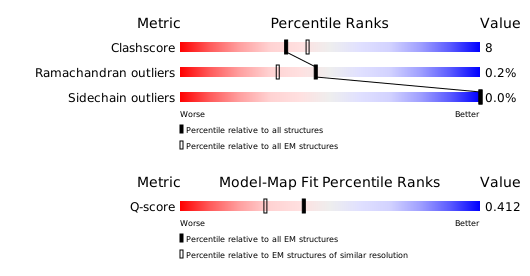
Structure validation
Download full validation report


