






 9WSV
9WSV
Cryo-EM structure of DAMGO-muOR-arrestin-1-Fab30 complex
Summary for 9WSV
| Entry DOI | 10.2210/pdb9wsv/pdb |
| EMDB information | 66207 |
| Related PRD ID | PRD_002308 |
| Descriptor | Mu-type opioid receptor,Vasopressin V2 receptor, Beta-arrestin-1, Fab30 heavy chain, ... (6 entities in total) |
| Functional Keywords | g-protein-coupled receptors, mu-opioid receptor, single particle, cryo-em, membrane protein |
| Biological source | Mus musculus (house mouse) More |
| Total number of polymer chains | 5 |
| Total formula weight | 136864.49 |
| Authors | |
| Primary citation | Zhang, H.,Wang, X.,Xi, K.,Shen, Q.,Xue, J.,Zhu, Y.,Zang, S.K.,Yu, T.,Shen, D.D.,Guo, J.,Chen, L.N.,Ji, S.Y.,Qin, J.,Dong, Y.,Zhao, M.,Yang, M.,Wu, H.,Yang, G.,Zhang, Y. The molecular basis of mu-opioid receptor signaling plasticity. Cell Res., 35:1021-1036, 2025 Cited by PubMed Abstract: Activation of the μ-opioid receptor (μOR) alleviates pain but also elicits adverse effects through diverse G proteins and β-arrestins. The structural details of μOR complexes with G and β-arrestins have not been determined, impeding a comprehensive understanding of μOR signaling plasticity. Here, we present the cryo-EM structures of the μOR-G and μOR-βarr1 complexes, revealing selective conformational preferences of μOR when engaged with specific downstream signaling transducers. Integrated receptor pharmacology, including high-resolution structural analysis, cell signaling assays, and molecular dynamics simulations, demonstrated that transmembrane helix 1 (TM1) acts as an allosteric regulator of μOR signaling bias through differential stabilization of the G-, G-, and βarr1-bound states. Mechanistically, outward TM1 displacement confers structural flexibility that promotes G protein recruitment, whereas inward TM1 retraction facilitates βarr1 recruitment by stabilizing the intracellular binding pocket through coordinated interactions with TM2, TM7, and helix8. Structural comparisons between the G-, G-, and βarr1-bound complexes identified a TM1-fusion pocket with significant implications for downstream signaling regulation. Overall, we demonstrate that the conformational and thermodynamic heterogeneity of TM1 allosterically drives the downstream signaling specificity and plasticity of μOR, thereby expanding the understanding of μOR signal transduction mechanisms and providing new avenues for the rational design of analgesics. PubMed: 41199005DOI: 10.1038/s41422-025-01191-8 PDB entries with the same primary citation |
| Experimental method | ELECTRON MICROSCOPY (2.8 Å) |
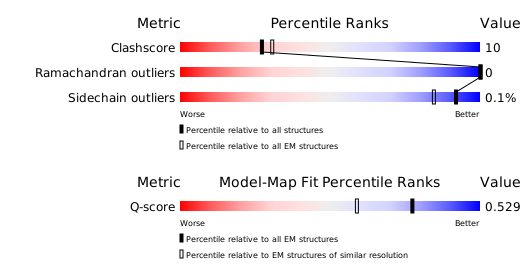
Structure validation
Download full validation report


