






 9VN5
9VN5
Structure of WDR5 in complex with MBD3C R43K
Summary for 9VN5
| Entry DOI | 10.2210/pdb9vn5/pdb |
| Descriptor | WD repeat-containing protein 5, Methyl-CpG binding domain protein 3 (3 entities in total) |
| Functional Keywords | wdr5, mbd3c, win motif, chromatin, nuclear protein |
| Biological source | Homo sapiens (human) More |
| Total number of polymer chains | 4 |
| Total formula weight | 71367.09 |
| Authors | |
| Primary citation | Pan, Y.,Li, H.,Chen, L.,Sun, X.,Xu, L.,Yang, Y. Structural insights into lysine-mediated WIN site recognition reveal an alternative "AK" motif for WDR5 binding. Biochem.Biophys.Res.Commun., 779:152440-152440, 2025 Cited by PubMed Abstract: WD repeat-containing protein 5 (WDR5) is a highly conserved chromatin-associated scaffold protein that recognizes short, arginine-containing WDR5 interacting (WIN) motifs in various partners to assemble transcriptional complexes. Although the WIN motif has been considered strictly arginine-dependent, our previous binding assays showed that the MBD3C_R43K variant retained binding to WDR5 (K = 1.31 μM), though the underlying mechanism remained unclear. Here, we report the crystal structure of WDR5 in complex with MBD3C (R43K) peptide at 1.9 Å resolution, revealing that lysine can also insert into the WIN pocket. Structural analysis shows that the lysine side chain mimics the canonical arginine interactions, forming hydrogen bonds with Ser91and engaging in hydrophobic contacts with Ser49, Phe133, Cys261, and Ile305 within the conserved WIN-binding site of WDR5. Interestingly, this experimentally determined structure contrasts with AlphaFold3 predictions, which incorrectly placed Arg45 into the WIN pocket rather than Lys43, underscoring the limitations of current predictive models for protein-peptide complexes involving mutations. Overall, our findings redefine the WIN motif consensus to include an alternative "AK" motif and highlight the contributions of residues at positions +2, +3, and +4 in stabilizing WDR5 binding. This work broadens the understanding of WDR5 substrate recognition and offers a structural framework for designing WIN-site inhibitors that target lysine-mediated interactions. PubMed: 40773920DOI: 10.1016/j.bbrc.2025.152440 PDB entries with the same primary citation |
| Experimental method | X-RAY DIFFRACTION (1.9 Å) |
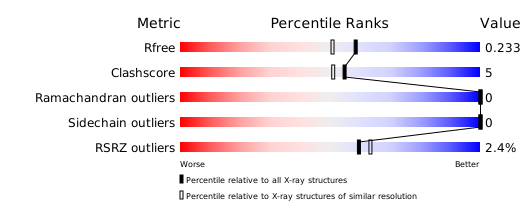
Structure validation
Download full validation report


