






 9VMM
9VMM
human CTPS1 with 2CTP and DON
Summary for 9VMM
| Entry DOI | 10.2210/pdb9vmm/pdb |
| EMDB information | 65191 |
| Descriptor | CTP synthase 1, CYTIDINE-5'-TRIPHOSPHATE, MAGNESIUM ION (3 entities in total) |
| Functional Keywords | ctp synthase, ctp, don, cytosolic protein, structural protein |
| Biological source | Homo sapiens (human) |
| Total number of polymer chains | 4 |
| Total formula weight | 271168.88 |
| Authors | |
| Primary citation | Guo, C.J.,Bao, X.,Liu, J.L. Filamentation of hCTPS1 with CTP. Cell Biosci, 15:112-112, 2025 Cited by PubMed Abstract: CTP synthase (CTPS) is a key enzyme in de novo CTP synthesis, playing a critical role in nucleotide metabolism and cellular proliferation. Human CTPS1 (hCTPS1), one of the two CTPS isoforms, is essential for immune responses and is highly expressed in proliferating cells, making it a promising therapeutic target for immune-related diseases and cancer. Despite its importance, the regulatory mechanisms governing hCTPS1 activity remain poorly understood. Here, we reveal that CTP, the product of CTPS, acts as a key regulator for hCTPS1 filamentation. Using cryo-electron microscopy (cryo-EM), we resolve the high-resolution structure of CTP-bound hCTPS1 filaments, uncovering the molecular details of CTP binding and its role in filament assembly. Importantly, we demonstrate that CTP generated from the enzymatic reaction does not trigger filament disassembly, suggesting a conserved regulatory pattern. Furthermore, by analyzing the binding modes of two distinct CTP-binding pockets, we provide evidence that this filamentation mechanism is evolutionarily conserved across species, particularly in eukaryotic CTPS. Our findings not only elucidate a novel regulatory mechanism of hCTPS1 activity but also deepen the understanding of how metabolic enzymes utilize filamentation as a conserved strategy for functional regulation. This study opens new avenues for targeting hCTPS1 in therapeutic interventions. PubMed: 40739251DOI: 10.1186/s13578-025-01450-6 PDB entries with the same primary citation |
| Experimental method | ELECTRON MICROSCOPY (3.3 Å) |
Structure validation
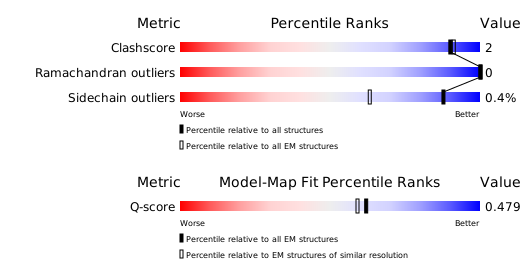
Download full validation report


