






 9V3S
9V3SSummary for 9V3S
| Entry DOI | 10.2210/pdb9v3s/pdb |
| EMDB information | 64755 |
| Descriptor | Sodium channel protein type 5 subunit alpha, 2-acetamido-2-deoxy-beta-D-glucopyranose, (~{S})-[(1~{S},2~{R},4~{S},5~{R})-5-ethenyl-1-azabicyclo[2.2.2]octan-2-yl]-[6-methoxy-3-[4-(2-phenylhydrazinyl)phenyl]quinolin-4-yl]methanol, ... (4 entities in total) |
| Functional Keywords | voltage-gated sodium channe nav1.5, membrane protein |
| Biological source | Homo sapiens (human) More |
| Total number of polymer chains | 1 |
| Total formula weight | 186553.94 |
| Authors | |
| Primary citation | Liu, S.,Guan, W.,Li, Z.,Wang, W.,Song, H.,Li, J.,Hou, J.,Wang, H.,Xiong, J.,Yang, M.,Yan, N.,Tian, X.,Li, H.,Huang, Z. Optical control of the cardiac rhythm with photoswitchable Na V 1.5 channel blockers. Nat Commun, 17:-, 2026 Cited by PubMed Abstract: Voltage-gated sodium channel Na1.5 is essential for cardiac excitability, mediating the rapid depolarization phase of the cardiac action potential (AP) and ensuring proper electrical conduction in the heart. Dysfunction of Na1.5 is implicated in life-threatening arrhythmias, making it a critical therapeutic target. Acting as a Na1.5 open-state blocker, quinidine demonstrates efficacy in arrhythmia treatment, but its low specificity restricts its clinical application. Here, we report an optopharmacological strategy that enables a precise and optical control of Na1.5 function by means of photoswitchable quinidine derivatives. Through systematic structural optimization, we identify azo-Q2a as a high-performance photoswitchable inhibitor, exhibiting low activity in the dark or under 480 nm light irradiation (trans isomer), while approximately 7-fold higher efficacy is observed under 365 nm light irradiation (cis isomer). Of note, azo-Q2a demonstrates exceptional selectivity for Na1.5 over cardiac ion channels and other Na1 subtypes, minimizing potential off-target effects. Furthermore, by solving the cryo-EM structure of the Na1.5 in complex with the cis-active isomer azo-Q2a (3.0 Å resolution), we reveal the essential binding site that is responsible for the optical control of Na1.5. Finally, azo-Q2a also attenuates the heart rate of living zebrafish larvae with light, showing its potential in cardiac-related research and treatment. Our work not only establishes azo-Q2a as a robust photoswitchable inhibitor for Na1.5 but also provides a structural blueprint for the rational design of next-generation optopharmacological antiarrhythmic agents. PubMed: 41807386DOI: 10.1038/s41467-026-70305-6 PDB entries with the same primary citation |
| Experimental method | ELECTRON MICROSCOPY (3 Å) |
Structure validation
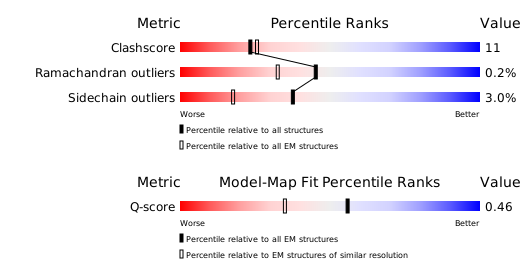
Download full validation report


