






 9UVI
9UVI
Crystal structure of beta 2 microglobulin in complex with antibody BBM.1
Summary for 9UVI
| Entry DOI | 10.2210/pdb9uvi/pdb |
| Descriptor | BBM.1 light chain, BBM.1 heavy chain, Beta-2-microglobulin, ... (4 entities in total) |
| Functional Keywords | immune system |
| Biological source | Mus musculus More |
| Total number of polymer chains | 3 |
| Total formula weight | 36070.32 |
| Authors | |
| Primary citation | Wu, J.,Zeng, F.,Wang, X.,Wei, P. Crystal structure of the beta 2 -microglobulin-BBM.1 antibody complex reveals the molecular basis of antigen recognition. Acta Crystallogr D Struct Biol, 81:473-481, 2025 Cited by PubMed Abstract: β-Microglobulin (βM) is an essential component of major histocompatibility complex class I (MHC-I) molecules, with a well established canonical role in immune surveillance. Beyond its classical functions, accumulating evidence has highlighted βM as a multifaceted biomarker, with elevated serum levels closely associated with disease burden and prognosis in metabolic disorders, malignancies, autoimmune diseases and central nervous system conditions. In this study, we resolved the crystal structure of human βM in complex with the mouse monoclonal antibody BBM.1 at 2.50 Å resolution using X-ray crystallography. Structural analysis revealed that BBM.1 binds βM through multiple CDRs, recognizing key surface residues including Glu36, Asp38, Lys41, Asn42, Glu44, Arg45, Glu47 and Arg81. The interaction is anchored by a central hydrophobic core formed by Trp32 (light chain), Trp99 (heavy chain) and Ile92 (βM), which is deeply buried in the interface. Surrounding this core is a well organized polar interaction network composed of hydrogen bonds and salt bridges, primarily involving βM residues Lys41, Glu44, Arg45 and Glu47. Notably, the Arg45 residue deeply embeds into the antibody-binding pocket, forming several crucial interactions. These findings not only validate previous biochemical and mutational data but also identify new epitope residues, providing a structural foundation for the development and optimization of precision therapeutic strategies targeting βM. PubMed: 40748259DOI: 10.1107/S2059798325006370 PDB entries with the same primary citation |
| Experimental method | X-RAY DIFFRACTION (2.5 Å) |
Structure validation
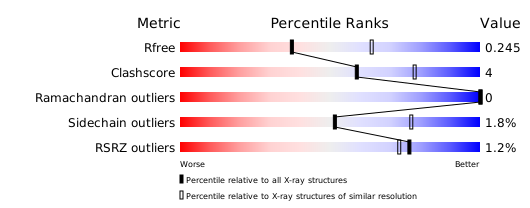
Download full validation report


