






 9UTM
9UTM
Crystal structure of an anti-CRISPR protein AcrIIA11
Summary for 9UTM
| Entry DOI | 10.2210/pdb9utm/pdb |
| Descriptor | AcrIIA11 (1 entity in total) |
| Functional Keywords | cas9, anti-crispr, viral protein |
| Biological source | Clostridium sp. OF09-36 |
| Total number of polymer chains | 2 |
| Total formula weight | 44818.23 |
| Authors | |
| Primary citation | Cao, X.,Gao, Z.,Yin, P.,Wang, H.,Yang, L. Crystal structure and inhibition mechanism of AcrIIA11. Biochem.Biophys.Res.Commun., 772:152073-152073, 2025 Cited by PubMed Abstract: Anti-CRISPR (Acr) proteins are naturally evolved inhibitors that precisely target and suppress CRISPR-Cas systems, representing a sophisticated molecular arms race between bacteriophages and their bacterial hosts. While Class 1 systems dominate among sequenced prokaryotic genomes, Class 2 systems remain primary sources of editing tools. Here, we report the structural and mechanistic characterization of AcrIIA11, an anti-CRISPR protein that simultaneously inhibits Streptococcus pyogenes (SpyCas9) and Staphylococcus aureus Cas9 (SauCas9). The 3.2 Å crystal structure reveals a compact α/β fold with distinct electropositive clefts implicated in DNA binding. While DALI analysis identified structural homology to transcriptional regulators and the RecA inhibitor PsiB (RMSD 3.3 Å), functional studies established that AcrIIA11 forms stable ternary complexes with both Cas9 orthologs and sgRNA. Biochemical assays demonstrated stronger inhibition of SauCas9 compared to SpyCas9, with EMSA revealing a critical dichotomy: AcrIIA11 maintains SauCas9-sgRNA binding to specific target DNA while completely blocking cleavage activity. Computational docking localizes AcrIIA11 at the HNH-RuvC interface without obstructing DNA-binding channels in SauCas9, suggesting allosteric inhibition through HNH domain displacement. This work establishes AcrIIA11 as a dual-purpose Cas9 inhibitor that preserves target recognition while inactivating nuclease function-a mechanism with potential applications in precision CRISPR control. PubMed: 40414010DOI: 10.1016/j.bbrc.2025.152073 PDB entries with the same primary citation |
| Experimental method | X-RAY DIFFRACTION (3.2 Å) |
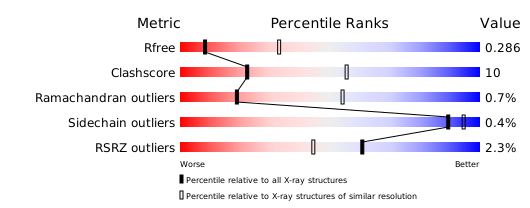
Structure validation
Download full validation report


