






 9UTC
9UTC
The VFT domains of human sweet taste receptor TAS1R2 and TAS1R3 in the sucralose-bound state
Summary for 9UTC
| Entry DOI | 10.2210/pdb9utc/pdb |
| EMDB information | 64488 |
| Related PRD ID | PRD_900090 |
| Descriptor | Taste receptor type 1 member 2,Taste receptor type 1 member 2,Engineered red fluorescent protein mScarlet3, Taste receptor type 1 member 3,mNeonGreen, 4-chloro-4-deoxy-alpha-D-galactopyranose-(1-2)-1,6-dichloro-1,6-dideoxy-beta-D-fructofuranose (3 entities in total) |
| Functional Keywords | gpcr, taste receptor, tas1r2, tas1r3, sucralose, signaling protein |
| Biological source | Homo sapiens (human) More |
| Total number of polymer chains | 2 |
| Total formula weight | 247495.46 |
| Authors | |
| Primary citation | Shi, Z.,Xu, W.,Wu, L.,Yue, X.,Liu, S.,Ding, W.,Zhang, J.,Meng, B.,Zhao, L.,Liu, X.,Liu, J.,Liu, Z.J.,Hua, T. Structural and functional characterization of human sweet taste receptor. Nature, 645:801-808, 2025 Cited by PubMed Abstract: Sweet taste perception influences dietary choices and metabolic health. The human sweet taste receptor, a class C G-protein-coupled receptor (GPCR) heterodimer composed of TAS1R2 and TAS1R3 (refs. ), senses a wide range of sweet compounds-including natural sugars, artificial sweeteners and sweet proteins-and affects metabolic regulation beyond taste. However, the lack of three-dimensional structures hinders our understanding of its precise working mechanism. Here we present cryo-electron microscopy structures of the full-length human sweet taste receptor in apo and sucralose-bound states. These structures reveal a distinct asymmetric heterodimer architecture, with sucralose binding exclusively to the Venus flytrap domain of TAS1R2. Combining mutagenesis and molecular dynamics simulations, this work delineates the sweetener-recognition modes in TAS1R2. Structural comparisons further uncover conformational changes upon ligand binding and a unique activation mechanism. These findings illuminate the signal transduction mechanisms of chemosensory receptors in the class C GPCR family and provide the molecular basis for the design of a new generation of sweeteners. PubMed: 40555359DOI: 10.1038/s41586-025-09302-6 PDB entries with the same primary citation |
| Experimental method | ELECTRON MICROSCOPY (3.33 Å) |
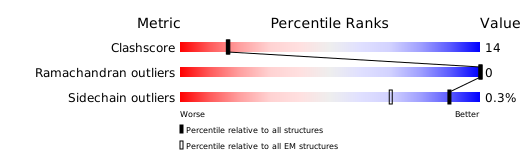
Structure validation
Download full validation report


