






 9UC5
9UC5
Mini-protein binder of N-terminal domain of nucleocapsid protein of SARS-CoV2
Summary for 9UC5
| Entry DOI | 10.2210/pdb9uc5/pdb |
| Descriptor | GPX62, SODIUM ION (3 entities in total) |
| Functional Keywords | sars-cov2 nucleocapsid binding protein, de novo protein |
| Biological source | unidentified |
| Total number of polymer chains | 2 |
| Total formula weight | 21985.94 |
| Authors | Khakerwala, Z.,Kumar, A.,Makde, R.D. (deposition date: 2025-04-03, release date: 2026-02-25, Last modification date: 2026-03-25) |
| Primary citation | Khakerwala, Z.,Kumar, A.,Gaikwad, S.S.,Barik, T.,Singh, S.,Gupta, G.D.,Makde, R.D. Experimental analyses of RFdiffusion designed Miniproteins for binding to SARS-CoV-2 nucleocapsid protein. Protein Eng.Des.Sel., 39:-, 2025 Cited by PubMed Abstract: Miniprotein designs are emerging as promising antibody alternatives for therapeutic and diagnostic use. Using RFdiffusion, we designed 538 binder candidates targeting both N- and C-terminal domains of the SARS-CoV-2 nucleocapsid protein, selecting 19 for recombinant production in E. coli. All were soluble and purified (8-10 mg/L yield), though 13 unexpectedly formed oligomers. CD spectroscopy confirmed proper folding and thermal refolding, with 9 miniproteins exhibiting Tm > 75°C. Binding assay revealed three miniproteins with affinities of 115 nM, 4.8 μM, and 7.32 μM. The 1.8 Å resolution crystal structure of one binder (Gpx62) matched the predicted design. However, predictive metrics (like ipTM of AlphaFold3 and computational simulations) did not align with experimental data. Together, these results reveal unintended oligomerization as a major, previously underappreciated barrier in miniprotein binder discovery, demonstrating that while RFdiffusion reliably predicts structural integrity and stability of miniprotein, its current metrics do not account for the oligomeric behavior that might critically limit binding competence. PubMed: 41665261DOI: 10.1093/protein/gzag004 PDB entries with the same primary citation |
| Experimental method | X-RAY DIFFRACTION (1.8 Å) |
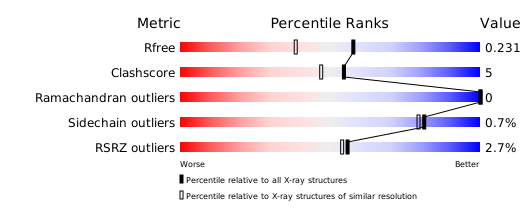
Structure validation
Download full validation report


