






 9U7E
9U7ESummary for 9U7E
| Entry DOI | 10.2210/pdb9u7e/pdb |
| Descriptor | Fibroblast growth factor receptor 2, (E)-4-methyl-17-(1-methyl-1H-pyrazol-4-yl)-7,10-dioxa-4-aza-1(3,6)-imidazo[1,2-b]pyridazina-2(3,5)-pyridinacyclodecaphan-3-one, SULFATE ION, ... (4 entities in total) |
| Functional Keywords | fibroblast growth factor receptor 2, transferase |
| Biological source | Homo sapiens (human) |
| Total number of polymer chains | 2 |
| Total formula weight | 70961.55 |
| Authors | Chen, X.J.,Chen, Y.H. (deposition date: 2025-03-24, release date: 2026-01-21, Last modification date: 2026-02-04) |
| Primary citation | Xiang, S.,Chen, X.,Lin, J.,Lin, X.,Lin, Q.,Song, X.,Yan, L.,Peng, H.,Tu, Z.,Patterson, A.V.,Smaill, J.B.,Tu, Y.,Chen, Y.,Lu, X. Design, Synthesis, and Biological Evaluation of the First Novel Macrocycle-Based FGFR Inhibitors That Overcome Clinically Acquired Resistance. J.Med.Chem., 69:1178-1198, 2026 Cited by PubMed Abstract: Alterations in the FGFR family act as oncogenic drivers for multiple pediatric and adult tumors, leading to the development and approval of several FGFR inhibitors. However, the on-target gatekeeper and "molecular brake" mutations confer clinically acquired resistance to the FDA-approved FGFR inhibitors, which presents a significant unmet medical need. Herein, we report the first novel macrocycle-based FGFR inhibitors targeting both wild-type and clinically acquired variants of the FGFR family. The representative compound potently inhibited FGFR1/2/3 with IC values of 10.0, 6.9, and 30.2 nM, respectively. Compound also potently suppressed proliferation of a series of FGFR-driven cancer cell lines with IC values of 2.0-13.3 nM. Compared with futibatinib, exhibited superior inhibitory activity toward FGFR1, FGFR2, and FGFR2 mutations with IC values of 6.8, 0.7, and 0.8 nM, respectively. Moreover, demonstrated favorable antitumor efficacy in an RT112/84 bladder cancer xenograft model. This work provides a promising macrocycle-based lead compound for the treatment of FGFR-driven cancers. PubMed: 41490805DOI: 10.1021/acs.jmedchem.5c02462 PDB entries with the same primary citation |
| Experimental method | X-RAY DIFFRACTION (2.2 Å) |
Structure validation
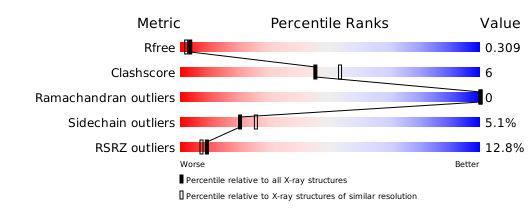
Download full validation report


