






 9SRX
9SRX
Cryo-EM structure of the Mlc repressor in complex with the glucose-specific IICB transporter
Summary for 9SRX
| Entry DOI | 10.2210/pdb9srx/pdb |
| EMDB information | 55165 |
| Descriptor | PTS system glucose-specific EIICB component, DNA-binding transcriptional repressor Mlc, beta-D-glucopyranose, ... (4 entities in total) |
| Functional Keywords | repressor, dna-binding protein, transcription regulation, gene regulation, carbohydrate utilization, metal-binding, membrane transporter, glucose, transmembrane protein, membrane-tethering, dna binding protein |
| Biological source | Escherichia coli More |
| Total number of polymer chains | 12 |
| Total formula weight | 606348.03 |
| Authors | Roth, P.,Fotiadis, D. (deposition date: 2025-09-25, release date: 2026-07-22, Last modification date: 2026-08-26) |
| Primary citation | Roth, P.,Fender, I.,Jeckelmann, J.M.,Ucurum, Z.,Lemmin, T.,Fotiadis, D. Structural basis of Mlc-mediated transcriptional regulation of carbohydrate metabolism. Nat Commun, 17:-, 2026 Cited by PubMed Abstract: The global transcriptional repressor Mlc of Escherichia coli regulates genes involved in carbohydrate transport and metabolism, particularly glucose uptake via the glucose-specific phosphotransferase system (PTS). Unlike conventional repressors, Mlc exemplifies a system in which interactions with diverse macromolecules govern its activity. Here, we present cryo-electron microscopy structures of Mlc alone and in complexes with regulatory partners, including the glucose-specific PTS transporter IICB, a cognate DNA operator and the anti-repressor MtfA, capturing multiple assemblies central to transcription control. These structures reveal the molecular architecture of Mlc and its interactions with binding partners. Together with molecular dynamics simulations, they provide insights into the structural dynamics of these complexes. Our findings establish the structural basis of membrane-transporter involvement in transcriptional regulation, the mechanism of anti-repressor action and DNA recognition. This work provides a structural framework for understanding bacterial transcriptional regulation across diverse systems. PubMed: 42436118DOI: 10.1038/s41467-026-75270-8 PDB entries with the same primary citation |
| Experimental method | ELECTRON MICROSCOPY (2.96 Å) |
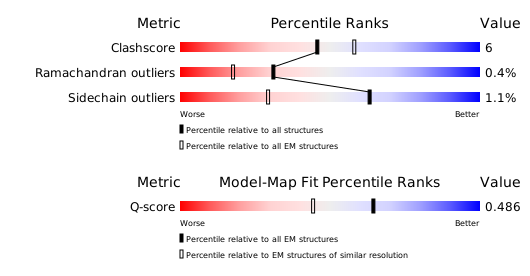
Structure validation
Download full validation report


