






 9RN6
9RN6
Crystal structure of a protein mimic of SARS-CoV-2 spike's HR1 domain in complex with two nanobodies bound to different epitopes
Summary for 9RN6
| Entry DOI | 10.2210/pdb9rn6/pdb |
| Descriptor | Spike protein S2',Chimeric protein mimic of SARS-CoV-2 Spike HR1, Nanobody NB278, Nanobody NB184 (3 entities in total) |
| Functional Keywords | neutralizing nanobodies; sars-cov-2; spike s2 subunit, viral protein |
| Biological source | Severe acute respiratory syndrome coronavirus 2 More |
| Total number of polymer chains | 3 |
| Total formula weight | 55469.44 |
| Authors | Camara-Artigas, A.,Conejero-Lara, F.,Polo-Megias, D.,Salinas-Garcia, M.C.,Gavira, J.A. (deposition date: 2025-06-19, release date: 2026-01-21) |
| Primary citation | Polo-Megias, D.,Cano-Munoz, M.,Trolese, P.,Lestani, S.,La Rocchia, I.,Pierangelini, A.,Fongaro, B.,de Laureto, P.P.,Morales-Yanez, F.J.,Vaneyck, J.,Vanderplasschen, A.,Decoville, T.,Laumond, G.,Salinas-Garcia, M.C.,Camara-Artigas, A.,Gavira, J.A.,Moog, C.,Dumoulin, M.,Conejero-Lara, F. Neutralizing nanobodies against SARS-CoV-2 recognizing highly conserved epitopes at the Spike's S2 subunit. Int.J.Biol.Macromol., 340:150022-150022, 2026 Cited by PubMed Abstract: The formation of a six-helix bundle between the conserved heptad-repeat regions 1 and 2 (HR1 and HR2) in SARS-CoV-2 Spike's S2 subunit is essential for membrane fusion and represents a promising therapeutic target. Previously, we reported recombinant proteins named CoVS-HR1, which mimic the HR1 region and block its interaction with HR2, inhibiting viral fusion. Moreover, they are recognized by plasma antibodies from COVID-19 convalescent patients. In this work, we generated camelid heavy-chain-only antibody fragments (VHHs), also named nanobodies (NBs), against a CoVS-HR1 variant mimicking the full HR1 region. A first generation of selected NBs bound HR1 with high affinity and competed with HR2. Notably, this set of NBs exclusively recognized the C-terminal half of HR1, and two of them showed mild neutralizing activity in cell infection assays. Using a truncated CoVS-HR1 variant (N2C), we selected a second generation of NBs targeting specifically the N-terminal half of HR1. However, these NBs did not demonstrate neutralizing activity, possibly due to their low binding affinities. Several NB epitopes were delineated by hydrogen‑deuterium exchange and mass spectrometry analysis, and the crystal structure of a ternary complex between an HR1-mimetic protein and two NBs was determined, confirming competition with HR2. Intriguingly, we found cooperative binding effects between NBs targeting each half of HR1, but these did not result in detectable inhibitory synergy. These findings demonstrate the existence of neutralizing epitopes in the S2 HR1 region and provide a foundation for future development of enhanced neutralizing NBs focused on specific epitopes using HR1-mimetic proteins. PubMed: 41506506DOI: 10.1016/j.ijbiomac.2025.150022 PDB entries with the same primary citation |
| Experimental method | X-RAY DIFFRACTION (2.4 Å) |
Structure validation
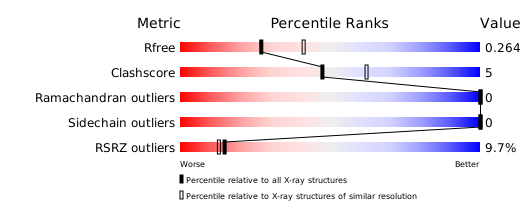
Download full validation report


