






 9RFA
9RFA
Apo structure of glxR
Summary for 9RFA
| Entry DOI | 10.2210/pdb9rfa/pdb |
| Descriptor | Probable oxidoreductase (2 entities in total) |
| Functional Keywords | fragment based drug discovery, kinase, hydrolase |
| Biological source | Pseudomonas aeruginosa |
| Total number of polymer chains | 4 |
| Total formula weight | 131962.44 |
| Authors | Brear, P.,Parkhill, S.,Wang, M.,Askenasy, I.,Cai, W.,Welch, M. (deposition date: 2025-06-04, release date: 2025-12-24, Last modification date: 2026-01-14) |
| Primary citation | Parkhill, S.L.,Little, O.,Askenasy, I.,Labrini, E.,Wang, M.,Brear, P.D.,Cai, W.,Deingruber, T.,Yang, T.,Spring, D.R.,Welch, M. An allantoin-inducible glyoxylate utilization pathway in Pseudomonas aeruginosa. Microbiology (Reading, Engl.), 171:-, 2025 Cited by PubMed Abstract: Fluorescent pseudomonads catabolize purines via uric acid and allantoin, a pathway whose end-product is glyoxylate. In this work, we show that in strain PAO1, the ORFs PA1498-PA1502 encode a pathway that converts the resulting glyoxylate into pyruvate. The expression of this cluster of ORFs was stimulated in the presence of allantoin, and mutants containing transposon insertions in the cluster were unable to grow on allantoin as a sole carbon source. The likely operonic structure of the cluster is elucidated. We also show that the purified proteins encoded by PA1502 and PA1500 have glyoxylate carboligase (Gcl) and tartronate semialdehyde (TSA) reductase (GlxR) activity, respectively, . Gcl condenses two molecules of glyoxylate to yield TSA, which is then reduced by GlxR to yield d-glycerate. GlxR displayed much greater specificity ( /K) for Gcl-derived TSA than it did for the TSA tautomer, hydroxypyruvate. This is relevant because TSA can potentially spontaneously tautomerize to yield hydroxypyruvate at neutral pH. However, kinetic and [H]-NMR evidence indicate that PA1501 (which encodes a putative hydroxypyruvate isomerase, Hyi) increases the rate of the Gcl-catalysed reaction, possibly by minimizing the impact of this unwanted tautomerization. Finally, we use X-ray crystallography to show that apo-GlxR is a configurationally flexible enzyme that can adopt two distinct tetrameric assemblies . PubMed: 41369682DOI: 10.1099/mic.0.001635 PDB entries with the same primary citation |
| Experimental method | X-RAY DIFFRACTION (2.069 Å) |
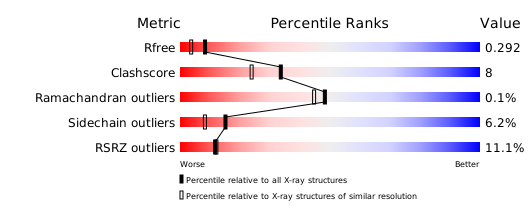
Structure validation
Download full validation report


