






 9QAM
9QAM
Human angiotensin-1 converting enzyme C-domain in complex with ciprofloxacin
Summary for 9QAM
| Entry DOI | 10.2210/pdb9qam/pdb |
| Descriptor | Angiotensin-converting enzyme, soluble form, 1,2-ETHANEDIOL, DI(HYDROXYETHYL)ETHER, ... (12 entities in total) |
| Functional Keywords | inhibitor, complex, antibiotic, ciprofloxacin, hypertension, hydrolase |
| Biological source | Homo sapiens (human) |
| Total number of polymer chains | 1 |
| Total formula weight | 69034.96 |
| Authors | |
| Primary citation | Gregory, K.S.,Ramasamy, V.,Sturrock, E.D.,Acharya, K.R. Ciprofloxacin Inhibits Angiotensin I‐Converting Enzyme (ACE) Activity by Binding at the Exosite, Distal to the Catalytic Pocket. Acs Bio Med Chem Au, 5:852-859, 2025 Cited by PubMed Abstract: Human somatic angiotensin I-converting enzyme is a key zinc metallopeptidase in cardiovascular regulation that hydrolyzes angiotensin peptides (Ang I, Ang II), as well as other vasoactive peptides, including kinins (e.g., bradykinin), substance P, the acetylated tetrapeptide Ac-Ser-Asp-Lys-Pro, and the amyloid ß-peptide. Because of its enzymatic promiscuity, ACE and its substrates and products affect many physiological processes, including blood pressure control, hemopoiesis, reproduction, renal development/function, fibrosis, and immune response. ACE inhibitors are among the most important therapeutic agents available today for the treatment of hypertension, heart failure, coronary artery disease, renal insufficiency, and general atherosclerosis. However, they need much improvement because of the side effects seen in patients with long-term treatment due to nonselective inhibition of the N- and C-domains of ACE (referred to as nACE and cACE, respectively). Here, we report that ACE activity can be inhibited by ciprofloxacin, a potent fluoroquinolone antibiotic (IC 202.7/ 33.8 μM for cACE). In addition, the high-resolution crystal structure of cACE in complex with ciprofloxacin reveals that it binds at an exosite away from the active site pocket, overlapping the position of a potential allosteric site with a different binding mode. The detailed structural information reported here will provide a useful scaffold for the design of future potent allosteric inhibitors. PubMed: 41112194DOI: 10.1021/acsbiomedchemau.5c00089 PDB entries with the same primary citation |
| Experimental method | X-RAY DIFFRACTION (1.85 Å) |
Structure validation
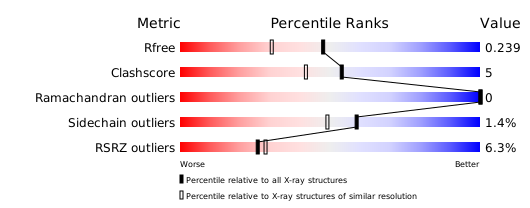
Download full validation report


