






 9PR7
9PR7
Cryo-EM structure of the human inward-rectifier potassium 7.1 channel (Kir7.1) with enantiomer of 17-hydroxyprogesterone caproate
This is a non-PDB format compatible entry.
Summary for 9PR7
| Entry DOI | 10.2210/pdb9pr7/pdb |
| EMDB information | 71800 |
| Descriptor | Inward rectifier potassium channel 13, [(2R)-2-octanoyloxy-3-[oxidanyl-[(1R,2R,3S,4R,5R,6S)-2,3,6-tris(oxidanyl)-4,5-diphosphonooxy-cyclohexyl]oxy-phosphoryl]oxy-propyl] octanoate, [(8~{R},9~{R},10~{S},13~{R},14~{R},17~{S})-17-ethanoyl-10,13-dimethyl-3-oxidanylidene-2,6,7,8,9,11,12,14,15,16-decahydro-1~{H}-cyclopenta[a]phenanthren-17-yl] hexanoate (3 entities in total) |
| Functional Keywords | inwardly rectifying potassium channel kir7.1, kcnj13, electrophysiology, ion channels, steroids, steroid enantiomers, membrane protein |
| Biological source | Homo sapiens (human) |
| Total number of polymer chains | 4 |
| Total formula weight | 166978.49 |
| Authors | Niu, Q.,Vu, S.,Zhang, R.,Fu, Z.,Lishko, P.V. (deposition date: 2025-07-23, release date: 2026-02-25, Last modification date: 2026-04-08) |
| Primary citation | Niu, Q.,Vu, S.,Xu, Y.,Qian, M.,Rudenko, A.,Ye, J.,Zeng, J.,Huang, W.,Covey, D.F.,Zhang, R.,Fu, Z.,Lishko, P.V. Bioactive lipid-mediated structural and functional regulation of the essential human potassium channel Kir7.1. Nat Commun, 17:-, 2026 Cited by PubMed Abstract: The inwardly rectifying potassium channel Kir7.1 is essential for the physiological function of diverse tissues, including the retinal pigment epithelium and the gestational myometrium. Loss-of-function mutations in KCNJ13, which encodes Kir7.1, or conditional ablation of Kir7.1 in the retinal pigment epithelium, lead to early-onset vision loss. Despite strong genetic evidence supporting Kir7.1 as a therapeutic target, its regulation by endogenous ligands-beyond phosphoinositides-remains poorly understood. Here, we report cryo-electron microscopy structures of human Kir7.1 in multiple functional states at resolutions ranging from 2.8 Å to 4.0 Å. These structures uncover the molecular basis of Kir7.1 modulation by PIP, its selectivity, rectification, and identify a distinct steroid-binding site that may mediate cooperative channel gating. Our data suggest that endogenous cholesterol acts as an inhibitory ligand, which is displaced by select activating steroids. These activating steroids work in concert with PIP to promote channel opening through profound changes in cytoplasmic domains, and the linker region. Electrophysiological analyses define a pharmacological landscape of Kir7.1 activators, providing innovative tools to probe and modulate channel function in both physiological and pathological contexts. PubMed: 41672996DOI: 10.1038/s41467-026-68819-0 PDB entries with the same primary citation |
| Experimental method | ELECTRON MICROSCOPY (4 Å) |
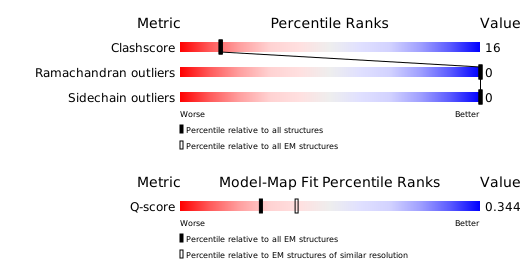
Structure validation
Download full validation report


