






 9PHC
9PHC
In vitro reconstituted complex of purified S. pombe large ribosomal subunit and SNOR
This is a non-PDB format compatible entry.
Summary for 9PHC
| Entry DOI | 10.2210/pdb9phc/pdb |
| EMDB information | 71645 |
| Descriptor | Large ribosomal subunit protein eL42, Large ribosomal subunit protein eL6, Large ribosomal subunit protein uL30C, ... (45 entities in total) |
| Functional Keywords | 60s, ribosome, large subunit, snor, pombe, yeast, hibernating, glucose |
| Biological source | Schizosaccharomyces pombe 972h- More |
| Total number of polymer chains | 44 |
| Total formula weight | 2019218.16 |
| Authors | |
| Primary citation | Gluc, M.,Rosa, H.,Bozko, M.,Turner, L.A.,Prince, C.R.,Peskova, Y.,Feaga, H.A.,Gould, K.L.,Mattei, S.,Jomaa, A. SNOR promotes translation restart after dormancy. Nature, 655:516-524, 2026 Cited by PubMed Abstract: Cellular dormancy enables survival during prolonged nutrient limitation by reversibly suppressing protein synthesis. How inactive eukaryotic ribosomes are reactivated when nutrients return remains unclear. Here, using high-resolution in situ cryo-electron tomography in Schizosaccharomyces pombe, we identify SNOR, an SBDS domain-containing ribosome-associated factor that binds at the peptidyl transferase centre and contacts the hypusinated loop of eIF5A during glucose depletion-induced dormancy. Rather than acting as a canonical hibernation factor, SNOR licenses dormant ribosomes for rapid translational restart. Upon glucose repletion, SNOR and eIF5A act together to promote efficient recovery of polysomes and exit from dormancy. These findings define a stress-responsive ribosome restart module that couples carbon-source limitation to surveillance of the ribosomal active site and reactivation of protein synthesis. PubMed: 42129552DOI: 10.1038/s41586-026-10530-7 PDB entries with the same primary citation |
| Experimental method | ELECTRON MICROSCOPY (2.8 Å) |
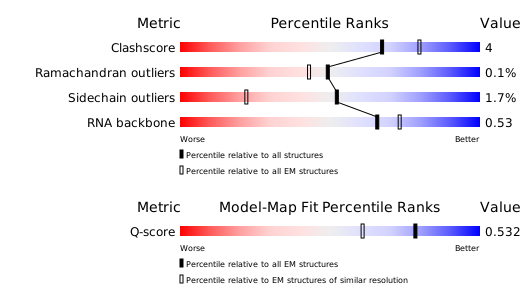
Structure validation
Download full validation report


