






 9PD2
9PD2
Crystal structure of PILRA in complex with Fab portion of antagonist antibody
Summary for 9PD2
| Entry DOI | 10.2210/pdb9pd2/pdb |
| Descriptor | Paired immunoglobulin-like type 2 receptor alpha, Anti-PILRA Fab Heavy Chain, Anti-PILRA Fab Light Chain, ... (4 entities in total) |
| Functional Keywords | receptor, complex, fab, antibody, signaling protein |
| Biological source | Homo sapiens (human) More |
| Total number of polymer chains | 3 |
| Total formula weight | 65305.88 |
| Authors | |
| Primary citation | Weerakkody, T.N.,Sabelstrom, H.,Andrews, S.V.,Chadarevian, J.P.,Chin, M.Y.,Tatarakis, D.,Propson, N.E.,Kim, D.J.,Theolis, R.,Parico, G.C.G.,Misker, H.,Kung, J.E.,Bandyopadhyay, A.,Robles Colmenares, Y.,Jackson, T.N.,Qerqez, A.N.,Balasundar, S.,Davis, S.S.,Ha, C.,Ghosh, R.,Ravi, R.,Rana, A.,Germain, K.,Tao, A.,Xiong, K.,Braun, D.,Raju, K.,Huang, K.C.,Zhan, L.,Guo, J.L.,Safari Yazd, H.,Sarrafha, L.,Capocchi, J.K.,Hasselmann, J.,Chadarevian, A.L.,Tu, C.,Mansour, K.,Eskandari-Sedighi, G.,Tesi, N.,van der Lee, S.,Hulsman, M.,Oshegov, G.,Pijnenburg, Y.,Calvert, M.,Holstege, H.,Suh, J.H.,Di Paolo, G.,Davtyan, H.,Lewcock, J.W.,Blurton-Jones, M.,Monroe, K.M. Loss of PILRA promotes microglial immunometabolism to reduce amyloid pathology in cell and mouse models of Alzheimer's disease. Sci Transl Med, 17:eadw7428-eadw7428, 2025 Cited by PubMed Abstract: The Alzheimer's disease (AD) genetic landscape identified microglia as a key disease-modifying cell type. Paired immunoglobulin-like type 2 receptor alpha (PILRA) is an immunoreceptor tyrosine-based inhibitory motif domain-containing inhibitory receptor, expressed by myeloid cells such as microglia. The known protective G78R gene variant reduces AD risk in () carriers and is enriched in a cohort of healthy centenarians. However, mechanisms underlying protective effects in microglia are undefined. Here, we identified biological functions of PILRA in human induced pluripotent stem cell-derived microglia (iMG) and chimeric AD mice. knockout (KO) in iMG rescued ApoE4-mediated immunometabolic deficits and prevented lipotoxicity through increased lipid storage, improved mitochondrial bioenergetics, and antioxidant activity. KO also enhanced microglial chemotaxis and attenuated inflammation. With pharmacological inhibitor studies, we showed that peroxisome proliferator-activated receptor and signal transducer and activator of transcription 1/3 mediated -dependent microglial functions. AD mice transplanted with human KO microglia exhibited reduced amyloid pathology and rescued synaptic markers. A high-affinity ligand blocking PILRA antibody phenocopied KO iMG. These findings suggest that PILRA is a pharmacologically tractable therapeutic target for AD. PubMed: 41337541DOI: 10.1126/scitranslmed.adw7428 PDB entries with the same primary citation |
| Experimental method | X-RAY DIFFRACTION (2.579 Å) |
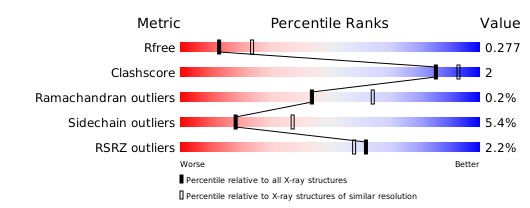
Structure validation
Download full validation report


