






 9P4E
9P4E
Crystal Structure of Engineered glutamine binding protein and a Gd-DOTA ligand - no GLN bound
This is a non-PDB format compatible entry.
Summary for 9P4E
| Entry DOI | 10.2210/pdb9p4e/pdb |
| Related | 9p4d |
| Descriptor | Amino acid ABC transporter substrate-binding protein, SULFATE ION, ACETATE ION, ... (8 entities in total) |
| Functional Keywords | amino acid abc transporter, substrate binding protein, metal binding protein |
| Biological source | Escherichia coli |
| Total number of polymer chains | 1 |
| Total formula weight | 26922.30 |
| Authors | Bruchs, A.T.,Wilson, C.A.,Boggs, D.G.,Fatima, S.,Bridwell-Rabb, J.,Olshansky, L. (deposition date: 2025-06-16, release date: 2026-01-14, Last modification date: 2026-02-11) |
| Primary citation | Wilson, C.A.,Bruchs, A.T.,Fatima, S.,Boggs, D.G.,Bridwell-Rabb, J.,Olshansky, L. Development of a glutamine-responsive MRI contrast agent. Chem Sci, 17:2781-2790, 2026 Cited by PubMed Abstract: Magnetic resonance imaging (MRI) is widely used to visualize disease, and image quality can be improved through use of MRI contrast agents. Currently available agents produce a signal based solely on spatial distribution, but modern metabolic profiling has uncovered a variety of biomarkers for disease. For example, tumors greatly increase their uptake and catabolism of glutamine (Gln), leading to modified local concentration. Our laboratory previously developed a switchable artificial metalloprotein (swArM) platform in which Gln-binding causes a protein conformational change that modifies the physicochemical environment of an installed metallocofactor. Installing MRI-active metallocofactors within swArMs, we present a proof-of-concept approch toward the development of an analyte-responsive MRI contrast agent. To develop these swArMs, we tested several MRI-active metals (Gd, Dy), chelating ligands (DOTA, DTPA, NOTA), and attachment sites, as well as the impacts of peripheral mutations on the Gln-responsive signal. In each case, metal content was analytically defined, and Gln-binding affinity was determined by isothermal titration calorimetry. Circular dichroism was used to verify that our swArMs could still undergo the conformational change. X-ray diffraction structures of the and swArMs further revealed that the metallocofactor is significantly solvent-exposed in both conformations, but exhibits additional interactions with the protein in the state coinciding with the observed increase in relaxivity of ∼60% upon Gln-binding. PubMed: 41395538DOI: 10.1039/d5sc05987a PDB entries with the same primary citation |
| Experimental method | X-RAY DIFFRACTION (2.02 Å) |
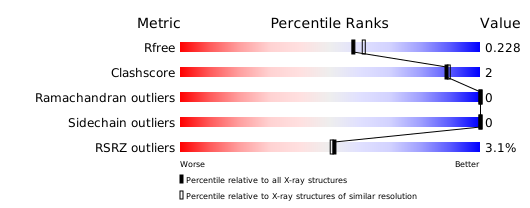
Structure validation
Download full validation report


