






 9OO6
9OO6Summary for 9OO6
| Entry DOI | 10.2210/pdb9oo6/pdb |
| EMDB information | 70660 |
| Descriptor | Isoform 3 of Protein-serine O-palmitoleoyltransferase porcupine,Green fluorescent protein, 2-[4-(2-methylpyridin-4-yl)phenyl]-N-[4-(pyridin-3-yl)phenyl]acetamide, Lauryl Maltose Neopentyl Glycol, ... (5 entities in total) |
| Functional Keywords | transmembrane protein, mboat, acylase, wnt acylase, enzyme, er, membrane protein |
| Biological source | Homo sapiens (human) More |
| Total number of polymer chains | 1 |
| Total formula weight | 83208.39 |
| Authors | |
| Primary citation | Black, K.A.,Mobbs, J.I.,Venugopal, H.,Dite, T.A.,Leis, A.,Wong, L.L.,Dagley, L.F.,Thal, D.M.,Glukhova, A. Structural basis for Porcupine inhibition. Commun Chem, 8:348-348, 2025 Cited by PubMed Abstract: Wnt signalling is essential for embryonic development and tissue homeostasis, and its dysregulation is associated with multiple types of cancer. Porcupine (PORCN), an endoplasmic reticulum (ER)-resident membrane-bound O-acyltransferase, catalyses the palmitoleoylation of all 19 human Wnts-a critical modification required for their secretion and activity. This central role makes PORCN an attractive therapeutic target for Wnt-driven cancers, with several inhibitors currently in clinical trials. Here, we present high-resolution cryo-electron microscopy structures of human PORCN in complex with the inhibitors C59 (2.4 Å) and ETC159 (2.6 Å), as well as in a ligand-free state (3.3 Å). These structures reveal critical ordered water molecules that form a hydrogen-bonding network within the active site, mediating inhibitor binding. Our docking simulations of diverse PORCN inhibitors demonstrate that despite their different chemical scaffolds, these compounds adopt similar conformations within the acyl-CoA binding site and are also engaged through a conserved water molecule. Our findings provide a structural foundation for the rational design of next-generation PORCN inhibitors with improved pharmacological properties for cancer therapy. PubMed: 41225132DOI: 10.1038/s42004-025-01726-5 PDB entries with the same primary citation |
| Experimental method | ELECTRON MICROSCOPY (2.39 Å) |
Structure validation
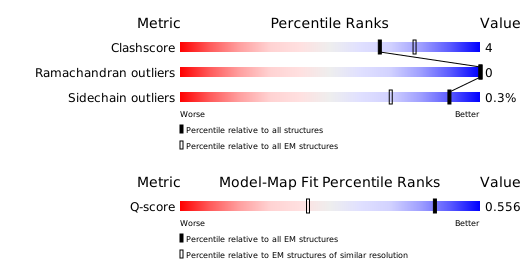
Download full validation report


