






 9OLX
9OLX
Structure of a constitutively open human TRPC3 mutant in the inhibited state
This is a non-PDB format compatible entry.
Summary for 9OLX
| Entry DOI | 10.2210/pdb9olx/pdb |
| EMDB information | 70601 |
| Descriptor | Short transient receptor potential channel 3, UNKNOWN LIGAND, (3,4-dihydroisoquinolin-2(1H)-yl)[2-(4-methoxyanilino)-1,3-thiazol-4-yl]methanone (3 entities in total) |
| Functional Keywords | trpc3, cerebellar ataxia, moonwalker, membrane protein |
| Biological source | Homo sapiens (human) |
| Total number of polymer chains | 4 |
| Total formula weight | 382459.81 |
| Authors | Bell, B.,Baker, M.L.,Cordero-Morales, J.F. (deposition date: 2025-05-13, release date: 2026-03-25, Last modification date: 2026-04-08) |
| Primary citation | Bell, B.,Jaramillo-Granada, A.M.,Romero, L.O.,Gutierrez, I.A.,Mallampalli, V.K.P.S.,Fan, G.,Varma, S.,Baker, M.L.,Serysheva, I.I.,Vasquez, V.,Cordero-Morales, J.F. Functional and structural basis of a hypermorphic TRPC3 variant. Sci Adv, 12:eaec9284-eaec9284, 2026 Cited by PubMed Abstract: Cerebellar ataxias are characterized by impaired motor coordination resulting from neuronal dysfunction within the cerebellum. The mechanisms underlying this pathology and its cerebellar-specific neurodegeneration remain unknown. We uncover how a gain-of-function canonical transient receptor potential member 3 (TRPC3) mutation, coupled with a cerebellum-specific isoform, stabilizes the channel's open state, resists the leading inhibitor Pyr3, and drives calcium-dependent cell death. Restoring calcium homeostasis by expressing a Purkinje cell calcium pump improves cell viability. Transgenic expression of the TRPC3 hypermorphic variant in induces neurodegeneration, confirming its pathogenicity across species. Cryo-electron microscopy and molecular simulations reveal the structural basis for the stabilization of the cerebellar-specific TRPC3 variant in its open state and uncover a druggable allosteric inhibitory binding site. These findings provide an explanation for the vulnerability of cerebellar neurons in TRPC3-associated ataxias and highlight a site for therapeutic intervention. PubMed: 41880503DOI: 10.1126/sciadv.aec9284 PDB entries with the same primary citation |
| Experimental method | ELECTRON MICROSCOPY (3.3 Å) |
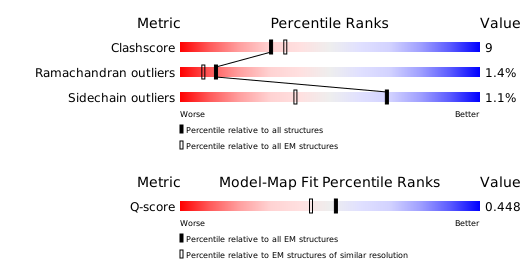
Structure validation
Download full validation report


