






 9OFU
9OFU
Dimer of HIF-1a-ARNT Heterodimers Complexed on 52-bp HRE/HAS
This is a non-PDB format compatible entry.
Summary for 9OFU
| Entry DOI | 10.2210/pdb9ofu/pdb |
| EMDB information | 70443 |
| Descriptor | Hypoxia-inducible factor 1-alpha, Aryl hydrocarbon receptor nuclear translocator, 52-nt Hypoxia Response Element (Forward), ... (4 entities in total) |
| Functional Keywords | complex, hypoxia, transcription, cancer, dimer, higher-ordered, dna binding protein |
| Biological source | Homo sapiens (human) More |
| Total number of polymer chains | 6 |
| Total formula weight | 204096.96 |
| Authors | Closson, J.D.,Tiyani, T.T.,Xu, X.,Gardner, K.H. (deposition date: 2025-04-30, release date: 2025-06-11, Last modification date: 2026-08-19) |
| Primary citation | Closson, J.D.,Xu, X.,Zhang, M.,Tiyani, T.T.,Marcelino, L.P.,Isiorho, E.A.,Nagati, J.S.,Garcia, J.A.,Gardner, K.H. Context-dependent variability of HIF heterodimers influences interactions with macromolecular and small molecule partners. Proc.Natl.Acad.Sci.USA, 123:e2514042123-e2514042123, 2026 Cited by PubMed Abstract: Hypoxia inducible factors (HIFs) are heterodimeric transcription factors that coordinate cellular responses to low oxygen levels by binding a short hypoxia response element (HRE) DNA sequence near O-regulated genes. Prior studies suggest HIF/HRE complexes are augmented by the binding of additional factors nearby, but those interactions are not well understood. Here, we integrated structural and biochemical approaches to investigate several functionally relevant HIF assemblies with other protein, small molecule, and DNA partners. First, we used cryo-electron microscopy (cryo-EM) to establish that HIF-1 and HIF-2 self-assemble into "dimer-of-heterodimers" (DoHD) complexes on extended human EPO enhancer sequences, with one heterodimer bound at a canonical HRE site and the second binding in an inverted fashion to an HRE-adjacent sequence 8 bp away. Consistent with ARNT PAS-B domains predominating interactions within a DoHD, we found HIF-1 and HIF-2 coassemble mixed DoHD complexes on the same DNA. Second, we saw that despite the increased complexities of the larger complexes, ligands for the isolated ARNT or HIF-2α PAS-B domains still bound and disrupted both heterodimeric and DoHD complexes, albeit with variable potencies depending on the ligand. Finally, we combined cryo-EM and hydrogen-deuterium exchange by mass spectrometry (HDX-MS) to show how HIF-1 and HIF-2 heterodimers engage the transforming acidic coiled-coil containing protein 3 coactivator via both ARNT and HIF-α subunits, though this was unseen in the larger DoHD. Our findings highlight the importance of molecular context in biomolecular complex formation, adding to the complexities of potential regulation. PubMed: 42048441DOI: 10.1073/pnas.2514042123 PDB entries with the same primary citation |
| Experimental method | ELECTRON MICROSCOPY (3.9 Å) |
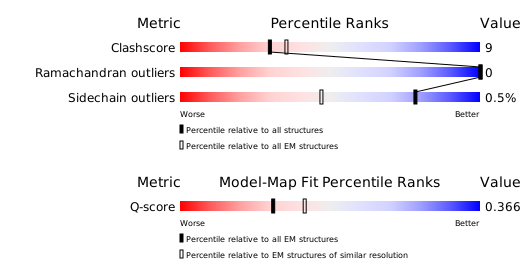
Structure validation
Download full validation report


