






 9O51
9O51
Cryo-EM structure of the human SK2-4 chimera/calmodulin channel complex in the Ca2+ free state
Summary for 9O51
| Entry DOI | 10.2210/pdb9o51/pdb |
| Related | 9O48 |
| EMDB information | 70120 |
| Descriptor | Intermediate conductance calcium-activated potassium channel protein 4,Small conductance calcium-activated potassium channel protein 2 chimera, Calmodulin-1, POTASSIUM ION, ... (4 entities in total) |
| Functional Keywords | ion channel, calcium, potassium, calmodulin, transport protein |
| Biological source | Homo sapiens (human) More |
| Total number of polymer chains | 8 |
| Total formula weight | 265177.34 |
| Authors | Cassell, S.J.,Khoshouei, M.,Wilhelm, W.A.,Whicher, J.R. (deposition date: 2025-04-09, release date: 2025-07-09, Last modification date: 2025-12-17) |
| Primary citation | Cassell, S.J.,Li, W.,Krautwald, S.,Khoshouei, M.,Lee, Y.T.,Hou, J.,Guan, W.,Peukert, S.,Weihofen, W.,Whicher, J.R. Mechanism of SK2 channel gating and its modulation by the bee toxin apamin and small molecules. Elife, 14:-, 2025 Cited by PubMed Abstract: Small-conductance calcium-activated potassium channel 2 (SK2) serves a variety of biological functions by coupling intracellular calcium dynamics with membrane potential. SK2 modulators are in development for the treatment of neurological and cardiovascular diseases, though the mechanisms of pharmacological modulation remain incompletely understood. We determined structures of an SK2-4 chimeric channel in Ca-bound and Ca-free conformations and in complex with the bee toxin apamin, a small molecule inhibitor, and a small molecule activator. The structures revealed that the S3-S4 linker forms a hydrophobic constriction at the extracellular opening of the pore. Apamin binds to this extracellular constriction and blocks the exit of potassium ions. Furthermore, we identified a structurally related SK2 inhibitor and activator that bind to the transmembrane domains. The compounds exert opposing effects on gating by differentially modulating the conformation of the S6 helices. These results provide important mechanistic insights to facilitate the development of targeted SK2 channel therapeutics. PubMed: 41342453DOI: 10.7554/eLife.107733 PDB entries with the same primary citation |
| Experimental method | ELECTRON MICROSCOPY (3.4 Å) |
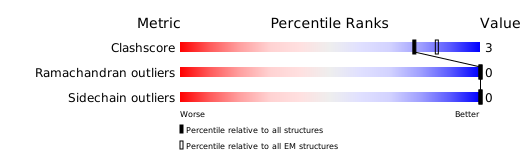
Structure validation
Download full validation report


