






 9NYI
9NYI
Structure of HalA in complex with oligodeoxyadenylate
Summary for 9NYI
| Entry DOI | 10.2210/pdb9nyi/pdb |
| EMDB information | 49920 |
| Descriptor | Structure of HalA in complex with oligodeoxyadenylate, DNA (5'-D(*AP*AP*AP*AP*AP*A)-3') (3 entities in total) |
| Functional Keywords | hailong, ion channel, oligodeoxyadenylate, anti-phage defense, antiviral protein |
| Biological source | Rhodobacteraceae bacterium QY30 More |
| Total number of polymer chains | 8 |
| Total formula weight | 173325.57 |
| Authors | Tan, J.M.J.,Melamed, S.,Cofsky, J.C.,Syangtan, D.,Hobbs, S.J.,Del Marmol, J.,Jost, M.,Kruse, A.C.,Sorek, S.,Kranzusch, P.J. (deposition date: 2025-03-27, release date: 2025-05-07, Last modification date: 2025-11-19) |
| Primary citation | Tan, J.M.J.,Melamed, S.,Cofsky, J.C.,Syangtan, D.,Hobbs, S.J.,Del Marmol, J.,Jost, M.,Kruse, A.C.,Sorek, R.,Kranzusch, P.J. A DNA-gated molecular guard controls bacterial Hailong anti-phage defence. Nature, 643:794-800, 2025 Cited by PubMed Abstract: Animal and bacterial cells use nucleotidyltransferase (NTase) enzymes to respond to viral infection and control major forms of immune signalling including cGAS-STING innate immunity and CBASS anti-phage defence. Here we discover a family of bacterial defence systems, which we name Hailong, that use NTase enzymes to constitutively synthesize DNA signals and guard against phage infection. Hailong protein B (HalB) is an NTase that converts deoxy-ATP into single-stranded DNA oligomers. A series of X-ray crystal structures define a stepwise mechanism of HalB DNA synthesis initiated by a C-terminal tyrosine residue that enables de novo enzymatic priming. We show that HalB DNA signals bind to and repress activation of a partnering Hailong protein A (HalA) effector complex. A 2.0-Å cryo-electron microscopy structure of the HalA-DNA complex reveals a membrane protein with a conserved ion channel domain and a unique crown domain that binds the DNA signal and gates activation. Analysing Hailong defence in vivo, we demonstrate that viral DNA exonucleases required for phage replication trigger release of the primed HalA complex and induce protective host cell growth arrest. Our results explain how inhibitory nucleotide immune signals can serve as molecular guards against phage infection and expand the mechanisms NTase enzymes use to control antiviral immunity. PubMed: 40306316DOI: 10.1038/s41586-025-09058-z PDB entries with the same primary citation |
| Experimental method | ELECTRON MICROSCOPY (1.98 Å) |
Structure validation
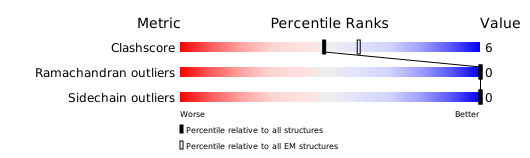
Download full validation report


