






 9NRN
9NRN
Lipoprotein Lipase Helical Filament with 11 nm diameter
This is a non-PDB format compatible entry.
Summary for 9NRN
| Entry DOI | 10.2210/pdb9nrn/pdb |
| EMDB information | 49737 49738 |
| Descriptor | Lipoprotein lipase (1 entity in total) |
| Functional Keywords | lipase, filament, helical complex, hydrolase |
| Biological source | Bos taurus (domestic cattle) |
| Total number of polymer chains | 18 |
| Total formula weight | 880225.88 |
| Authors | Gunn, K.H.,Wheless, A.,Neher, S.B. (deposition date: 2025-03-14, release date: 2025-08-13, Last modification date: 2025-08-20) |
| Primary citation | Gunn, K.H.,Wheless, A.,Calcraft, T.,Kreutzberger, M.,El-Houshy, K.,Egelman, E.H.,Rosenthal, P.B.,Neher, S.B. Cryogenic electron tomography reveals helical organization of lipoprotein lipase in storage vesicles. Sci Adv, 11:eadx8711-eadx8711, 2025 Cited by PubMed Abstract: Lipoprotein lipase (LPL) is a triglyceride lipase that is contained in intracellular vesicles in an inactive storage form before secretion, but the precise structural details have not yet been resolved. Using cryo-electron tomography (cryo-ET), we observe that LPL exists inside of storage vesicles as a filament with an 11-nanometer diameter and is packed in these vesicles in two distinct patterns. Next, we solved a 4.2-Å resolution cryo-electron microscopy (cryo-EM) structure of this 11-nanometer LPL filament using purified protein. The filament is made of repeating pairs of LPL molecules with occluded active sites, rendering the LPL inactive. The comparison of the in situ subtomogram average and the in vitro cryo-EM structure indicates that the previously uncharacterized physiological storage form of LPL is an inactive filament. PubMed: 40768583DOI: 10.1126/sciadv.adx8711 PDB entries with the same primary citation |
| Experimental method | ELECTRON MICROSCOPY (4.2 Å) |
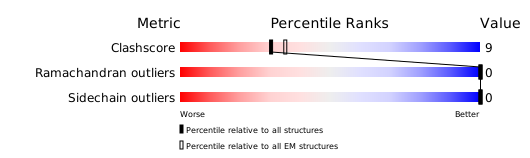
Structure validation
Download full validation report


